
Tag: Entrepreneurship

Financial Education through Real Estate Investing — Complete your Wheel of Wealth for a Smooth Financial Journey (Part 2/2)
April 12, 2022
First off, I want to share a quick example on WHY understanding the Wheel of Wealth is so vitally important for anyone who wants to go PRO in the world of real estate investing.
I have worked with many students that were worth so much more than me when they come to me for help. They’ve simply done really well by following the basics: get good jobs, make high incomes, control expenses and buy properties. Properties that initially never cash flowed until market rents caught up. Even then, the cash flow amounts were pathetic (their word, not mine) because they were waiting for the big cash out once the mortgages are fully paid down…in 20, 25 or 30 years.
Very quickly, through one on one discussions and seeing how they handle opportunities that come their way, it’s ‘habitual’ for them to just ‘buy’. These also tend to be the people that have told me “somedays, I/we feel like slaves to our jobs, our properties AND our tenants. We pay them to be there because we don’t make any money until the very end.” They have this uncontrollable need to BUY and COLLECT. Before you know it, two, three and maybe even four decades have gone by. That’s great if that’s what you’d like and are able to put up with decades of stress like that. These are the people (I really don’t call them investors) that only feed into 2 buckets still: earned and portfolio. To me, those are the two income buckets that any average person has been taught to do growing up as discussed in Part 1. This is interesting to me because it’s like putting a driving coach in a car with someone who’s been driving for 20 years. Even with a good clean driving records, the driving coach can typically pick out “bad habits” that are blind spots to the long-time driver within seconds.
For many, it’s about rewiring our thought process and financial blueprint. Again, don’t get me wrong, there’s nothing bad about retiring with a buttload of portfolio income. It’s just that, one of my mentors in my early days asked me this question that really stopped me cold: do you want to be young and rich or old and rich? The key word here is not rich. It’s TIME.
The concept of time needs to be the first concept for all investors to learn and fully comprehend before anything else matters.

Onthat note, let’s come back and look at the hard and soft strategies again first:
- Distressed Properties & Flip (physical buy and sell of a property)
- Wholesale & Assignment (paper buy and sell of a property)
- Lease Options (physical or paper buy and sell of a property)
- Short-Term Rentals: vacation, executive, student and rooming houses
- Private Lending & Creative Financing
- Income Properties: single family
- Income Properties: multi-unit residential
- Income Properties: commercial, mixed use and industrial
- Infills and Land Development
- Asset & Income Protection
- Business Fundamentals: business planning & goal setting, bookkeeping, systemization, networking, etc.
- Portfolio Management: tenant management & management of the physical asset
- Raising Capital
- Creative Financing: small to large scale partnerships
Frankly, this list is not exhaustive, yet. In different countries/jurisdictions, there are many more available. However, for the sake of demonstrating the concept, we’ll keep this list for now.
From this point forward, typically we have 2 main steps on how to complete the Wheel of Wealth with the 14 listed strategies:
First — understand which income bucket each strategy goes into, and
Second — understand how to use it to our advantage to accomplish our financial goals.
Distressed Properties & Flip (physical buy and sell of a property)
This hard strategy falls under earned income for most especially when the clear ‘exit’ is to sell it once the value-add process is done. However, one thing to note is that distressed properties really is the foundational strategy of all property-first deals. As a result, many people have heard of the BRRRR process. BRRRR stands for Buy, Renovate, Rent, Refinance, and Repeat. It’s also important to know that BRRRR is NOT a strategy in itself as we BRRRR all property types (even businesses!). Amateurs who want to sound fancy will often times refer to this as a strategy. Please do not sound like one after reading this article — you’re better than that 🙂
I would personally put this strategy in all 3 income buckets if the exit strategy isn’t to sell immediately after the value-add (aka renovation) is done. Why? Because of one very crucial thing pointed out earlier — it is the foundational strategy of all property-first deals. Whether it’s a small single family, a 12-unit apartment building or 1,000-unit apartment building complex (or even commercial and industrial units), you will BRRRR them. And when you decide to keep them for cashflow, you now have passive and portfolio income for the long haul. While not directly in the passive and portfolio income buckets, it definitely is a main contributor for both.
Wholesale & Assignment (paper buy and sell of a property)
This hard strategy falls under the earned income bucket. Simple. Be the personal shopper in the real estate investing industry is what I call a wholesaler — doesn’t that sound fun?!
Lease Options (physical or paper buy and sell of a property)
Oh boy, this one is gonna be fun. Like distressed properties, this one contributes to all 3 — earned, passive and portfolio — income buckets. Unlike distressed properties, it can do it in a very direct ways. It’s worth noting that lease options can be used as both acquisition and exit strategies in real estate transactions. Frankly, for my readers who do day trading, you simply don’t need anymore explanation on this one.
Short-Term Rentals (STRs): vacation, executive, student and rooming houses
Definition matters in the world of investing. How we define short-term rentals is simply by the length of a typical tenancy which is 12 months. STRs can be either earned OR passive+portfolio income depending on one main factor: are you the active manager dealing with your tenants and bookings? If you are, then it’s likely an earned income bucket strategy for you. If you are hiring out the day-to-day management, then it’s simply passive+portfolio on properties that you have in your portfolio.
Private Lending & Creative Financing
First thing first, if you’re not licensed to trade in loans and mortgages, tread carefully on how you allocate this strategy into your income buckets. For example, mortgage brokers are legally licensed to trade in loans and mortgages. Most private investors aren’t. Amongst your close circles, you are able to leverage this strategy and feed all 3 — earned, passive and portfolio — income buckets. Certain creative financing methods will feed into your passive+portfolio income buckets only.
Income Properties — all kinds
Income Properties, by definition, is making you income every month so it definitely checks off the passive income bucket box. However, when done right and well, all income properties should feed into your portfolio income bucket as well. There are certain formula and key performance indicators as our north star to make sure both buckets are fed properly. Otherwise, we are no better than the example in the opening story.
Infills & Development
Perhaps the strategy that has the widest spectrum as you can build whatever you want here! Once again, to keep things simple, infills and development is what I would describe as distressed properties on mega steroids (except that maybe there isn’t an actual piece of dwelling sitting on the land sometimes and it’s just…land). As a result, if you sell it once it’s built, it’s definitely goes into your earned income bucket. If you hold on to it, it turns into an income property and thus feeding into your passive and portfolio income buckets.
Taking a turn here, ALL soft strategies go into all 3 income buckets. That makes it easy. Whew!
Now that we’ve gone through that, let’s make it a bit more relevant and start speaking everyday English, shall we?
Let’s say: if your why for investing is because you’d like to —
- Have better vacations with the fam every year
- Your job is “stable” — meaning your hours and stress levels and earning potential are predictable and capped
- You want to pick up a lucrative side hustle without the extra tax bills
You might be perfect for a mixture of distressed properties & flip, wholesale & assignment, and lease options.
Let’s say: if your why for investing is because you’d like to —
- Secure your retirement because, frankly, every time you look at your quarterly statements from whatever it is your money is in, you lose a few nights of sleep
- Make sure you don’t become 100% dependent on the government or, worse yet, become a burden to your children
You might be perfect for a mixture of lease options, income properties (types of property dependent upon your personal risk tolerance) and private lending & creative financing.
Let’s say: if your why for investing is because you’d like to —
- Have time and money freedom and enough to fire your boss one day (date TBD)
- Build and live a life by design and with purpose
You might be perfect for a mixture of lease options, income properties, STRs, private lending & creative financing.
Of course, there are many ‘it depends’ in every scenario. However, I hope that the essence of the thought process here is captured and understood.
Toconclude the whole concept of WHY it’s important to understand and complete your own Wheel of Wealth: you will never have to ask which market(s) to go into ever again. One of my mentors said this to me: build your own wheel so you never have to chase markets. Across the world right now, changes are happening everywhere — rising interest rates, governments capping rent increases, higher than ever before-seen property values, highest inflation rate and climbing every quarter, etc. Change is the only constant. When you round out your own Wheel, you never have to worry about what the market is doing. For instance, we started building (infill & development) in 2017 long before the amateurs are flocking into developing new properties because they just learned that there’s an overall shortage of housing in the country. I learned that when I was building my passive income, there were already people developing. And that precisely IS the point here: we are all at different stages of our wealth creation plan. When you have built yourself a safety net, it doesn’t matter what’s happening to the world. You’re financially independent and free first before you take on more (calculated) risk.
Inthe next article, I will share with our personal investing philosophy and, more importantly, process. It has been my guiding light for the last 7 years. Yes, 7 out of the 12 years since I started learning and applying because I finally figured out a formula that can be duplicated. A formula that will compliment the Wheel of Wealth and has the potential completely alter how you look at real estate as an investment tool.
For my dedicated readers, I thank you for your support and feedback. If this is the first time you’re reading one of my publications, I hope you’ve enjoyed it and learned a thing or two.
For those of you who prefer watching videos, here is the YouTube channel where some of my work (very raw) has been shared.
Financial Education: Understanding the 5 C’s of Credit
June 28, 2022
Great…first “the 5 factors” that determine my credit score. Now another 5 C’s…how many five-somethings are there?!
Don’t you worry. There aren’t many. Perhaps, I’ll share the “5 Rules of Investing” next. Joking…NOT joking!
First of all, I will say that a seasoned and experienced Mortgage Broker can explain this much better. So, once again, my disclaimer is this: I will review these 5 C’s from an investor/entrepreneur’s perspective.
What are the 5 C’s of Credit?
Many of us have never even heard of this and yet, arguably, this is probably more important than our credit scores.
The 5 C’s are:
- Character
- Capacity
- Capital
- Collateral
- Conditions
These are universally applicable measuring sticks with (especially) institutional lenders worldwide.
As I’ve mentioned previously: when it comes to credit, it’s better to have it and not need it, than to need it and not have it. (And I will keep mentioning this again and again…and again…)
Whenever we are applying for a credit product — personal loan, line of credit, mortgage, business loan or just a new credit card — the lender will want to know you can pay back the money as agreed. Pretty simple in theory, right? Well, on paper, they don’t know you as a person and they cannot tell you apart from me based on an application. They only way to really assess your credit worthiness is through the 5 C’s.
Let’s jump in.
Character
While it’s called “character”, this is referring directly to your credit history — how you’ve managed your debt in the past.
This can be easily achieved usually by pulling your credit score as a quick glance (refer to the previous articles to learn more). We all start developing our track record (aka credit history) the moment we start taking our credit products. Yes, that includes getting a cell phone bill in your name, a cable service and making sure your apartment gets heat and water.
The extenders of these products (aka lenders) may choose to report their observed behaviour on you as a borrower to a (or multiple) credit bureaus.
In essence, character in this case can be tied directly back to your credit report and the 5 factors that determine your credit score. However, let’s not forget that a credit report will contain more information on your track record other than you’re managing your credit card bills, mortgages, car payments and lines of credit. It may also contain information on any foreclosure or bankruptcies that have happened.
A tangent here — as far as I know, if you’re ever thinking about getting a mortgage again, it’s easier if you’ve had a bankruptcy on your file than a foreclosure. Why? Think about it this way: a foreclosure means you did not (or could not) make your mortgage payments (and usually for an extended amount of time) as promised. This is largely seen as a ‘voluntary’ act. As a result, why would another lender give you the same type of loan? Feelings or no feelings, we can all understand the idea of “once bitten twice shy”.
Other the other hand, a bankruptcy could’ve been caused by many other factors that are considered as ‘involuntary’ — a divorce, a failed business, an injury that has negatively impacted your ability to debt service, etc. However, this is not to say it’s better to declare a bankruptcy when you’re in financial hardship than going into foreclosure. Ideally, you want neither on your file (duh!).
Lastly, to develop a strong credit history, always make payments on time and keep your credit utilization at a generally reasonable/acceptable rate (again, see previous articles for clarification).
Capacity
Your capacity refers to your ability to repay loans/debt.
This is determined by evaluating your debt to income ratio. Depending on where you live, you may have heard of terms such as ‘total debt servicing ratio (TDSR)’ or ‘gross debt servicing ratio (GDSR)’.
Generally, a low DSR (debt servicing ratio) signifies less risk for a lender because it’s tell the lender that you:
- have a reasonable amount of debt, and
- are managing your debt well, and
- have the capacity to take on more (on a monthly or annual basis).
Every lender is going to have a DSR. I’ve learned that the DSR can change quite drastically especially when the lender has an appetite to grow their marketshare in certain loan products.
Regardless, here a quick calculations on how DSR is done: add up all your monthly debt payments and dividing that number by your monthly pre-tax (gross) PROVABLE income. Then multiply it by 100(%). And, if you are watching My Daily Dose with Tim, you’ll see how important one of the key performance indicators (KPIs) called the Coverage Ratio (or DSCR — debt service coverage ratio) is when it comes to the lender’s evaluation of a larger building.
Lastly, “when it comes to credit, it’s better to have it and not need it than to need it and not have it”. This doesn’t mean that you get to use your available credit to shop for anything you want. A smart investor leverage credit and debt to build income and wealth.
Capital
Capital tend to include the cash and liquid (or liquidable) assets that you are willing to put towards the loan product you’re applying for. One biggest example is getting a mortgage.
Typically speaking, the larger the downpayment, the better your interest rate and terms will be. That’s because the amount of your downpayment is a direct message to your lender how much ‘skin in the game’ you have. You are serious! Of course, as an investor, one of the main reasons why we love real estate is because we have the ability to leverage up to 80% on investment properties. This means that we can come up with 20% in downpayment against the purchase price of a property. This also means we often will be kickin’ and screamin’ when it needs to be more than 20%.
Lastly, I do not endorse the concept of saving money by any stretch of the means. Tucking money away in savings accounts of any type is possibly the worst way to ‘accumulate’ capital for any investment deals. While you may start to understand/feel this due to the recent inflation numbers, many people in your immediate circles (parents, siblings, best friends, close colleagues, etc.) may be feeling that, too. Everyone wants to work less themselves and their money to work harder for them. This is why I keep repeating what I was taught: when the deal is good, the money will follow. Raising funds to grow and stabilize your portfolio is way smarter and more sustainable (when done properly) than constantly trading hours for dollars to save.
Collateral
Collateral in this case goes beyond the liquid cash (or downpayment) that you may have from your savings and stock portfolio. It includes those plus investments and assets that you are willing to put toward your home. Essentially, a lender will consider the value of your personal (business if applicable) assets of a secondary source — while not ideal — of repayment.
Collateral often times is a significant part of the consideration to a lender. However, the significance of each type of collateral can change depending on the type of loan you are getting. I often think of a lender like an investor. They are giving you the loan largely based on the ‘deal’ you have on the table. They are essentially your partner. As educated investors, we know that “when the deal is good, the money will follow”. This is why, typically speaking, the asset or the deal itself is the first and most significant collateral. Because if the lender does not deem it as a good ‘investment/deal’, you wouldn’t even be considered in the first place.
Lastly, this is why active investors have all heard about ‘qualification based on net worth’ over time. Because the lenders tend to feel a lot safer when they know their money is safe and that there is a lot to ‘go after’ if a high net worth borrower defaults. In the beginning of my career as an investor, the collaterals largely relied on the asset itself (which is great because I chose real estate as my main investment vehicle), my ability to repay on the monthly basis. Later on, it’s become the asset itself and what’s in my overall portfolio. This also sparks the conversation about asset protection. Many make the mistake to put everything in their personal name to boost their net worth right away and choose to continue it that way. Any financially educated person will tell you that is simply…well, stupid. That will be a whole other subject altogether at a later time.
Conditions
These usually refer to the lender’s micro- and macro-research (‘due diligence’) on the condition of the investment, the business, the industry, the economy and (in my opinion), most importantly, the borrower’s intention and plan with the funds borrowed. Most lenders are more inclined to lend money for a specific purpose as opposed to a general loan that can be used for anything by the borrower.
The other external factors like how the economy is, where it’s going, the federal interest rates and budget, etc. are out of any of our control (largely speaking unless you’re the wealthiest person or the most politically influential person on the planet). Every lender has a different perspective and appetite for taking on risks. What we tend to see is then the requirement for a larger ‘skin in the game’ for the borrower.
Lastly, from my personal experience, this is why I remain fond of single family home investing. I understand the path of trading ‘four green houses for one red hotel’. I also understand that everyone needs (and more importantly — WANTS) a roof over their head at the end of the every day regardless of the economic conditions. It’s never about investing for fame or for bigger profit for me. It’s about investing for freedom, for security, for happiness, for choices in life and for the opportunity to make a difference in other people’s lives also. While external conditions may change quickly and drastically (remember: change is the only constant), when we are smart and financially educated enough to think for ourselves, helping others get what they want is ultimately how we create what we want. Or better yet, I’ll end with this Zig Ziglar quote:

Tomy dedicated readers, I thank you for your support and feedback. If this is the first time you’re reading one of my publications, I hope you’ve enjoyed it and learned a thing or two.
If you’re wanting to be a part of a community of real estate investors from around the globe, here is the T.A.L.E.N.T.ed Investors Facebook Group. It’s a place where people come together to share experiences, knowledge, successes and challenges, and money making opportunities!
For those of you who prefer watching videos, here is the YouTube channel where some of my work (very raw) has been shared.

Lastly and definitely not least, Bootcamp! If you prefer the live interaction and delivery to help you build some foundation, our next Bootcamp is on July 23 and July 24. Go ahead and register for a session for either day to help you further your financial education.
(Written at the Anaheim Marriott in Anaheim, CA)

5 Daily Habits that Help me Create Sustainable Success
July 5, 2022
(WARNING: COLOURFUL LANGUAGE)
“Alright, Tim’s gone mad.” is probably the thought that some of you had when seeing this title. “Either that, or he’s delusional.” is probably another thought you had.
Hear me out here…
While sharing about financial education, building businesses and creating financial successes is something that speaks to the entrepreneur in me, sharing with you how some of the habits I’ve dedicated myself to building over the years speaks to my soul.
With all the uncertainties happening these days — the economy, the interest rates, the bond yields, the stock market and the real estate markets — fear and negative self talks rear their ugly heads in all of us. Yes, in me too. However, this is the time when we have to remind ourselves that EVERYTHING IS CYCLICAL — especially the different factors mentioned here.
I am not here to compare myself to anyone else when I say “staying power matters” since I can only say that I’ve been truly entrepreneurial for about 20 years, and have found any substantial financial success in the last 10. For that reason, I will always have respect for any entrepreneurs that have lasted decades regardless of their current reputation. They’ve done something (or many things) to keep them in the game through the changes and cycles over time.
Like everything we do, mindset is huge and arguably the ultimate determining factor of the successful vs the unsuccessful. Note — it’s not the successful vs the failed. But how we feel about what we do is often times neglected in the business world. Everyone wants the ‘how to’. From the yellow dummy books to the gazillion searches on YouTube for how-to videos, we forget that most of us only do what we want to do most of the time.
Learning about and managing my energy level and mental state daily are what I attribute the exceptional growth during uncertain times to— especially in the last 5 years between the regional recession in my home province and a global pandemic.
Asa business owner and a real estate investor, I can quickly and easily default to sharing business tactics and strategies, and even step by step guides on what I’d do in any given situation when there’s a problem to be solved.
Here, I want to start with something between mindset (abstract) and strategy (concrete): habits.
While I’ve consumed books, speeches, and taken countless personal development courses and 1-on-1 coaching sessions, there will be no empirical data nor science shared other than personal experiences and perspectives. Remember: something between mindset and strategy.
1. Unsubscribe
Welive in a world where we’re conditioned to seek information quick and easy. It’s even easier if it’s just fed to us regularly without having to lift a finger for the second time.
Starting today, unsubscribe from 1 thing daily. I honestly do not recall if I learned this somewhere or just got completely fed up with the amount of junk and spam emails one day. I started by unsubscribing to mailing lists first. You know — the kind that takes time and mental space, and sometimes even your hard earned money for no good reason.
Perhaps you ‘subscribed’ initially because you were actually seeking a particular service, product, a piece of information, etc. However, if it’s not contributing to your day-to-day efficiency or functionality, unsubscribe now. It’s ok to search for it again later when you actually need it again (thanks, Google!).
For me, this is as simple of taking a couple of minutes a day and hitting the unsubscribe buttons — travel sites, newsletters, retail stores and even search lists set up with real estate agents in a market that you once were interested in. Some days, it’s a more drawn out process of saying goodbye to ‘friends’ that I’ve actually never exchanged words with online. It’s drawn out because I would often times send a quick message first before removing them altogether. After all, I’m not a robot. At some point in time, I’ve either sought out to connect or they did — for a reason. I’d like to honour that reason. Perhaps I was the one that dropped the ball initially on making any kind of meaningful connection.
If you do this for the next 30 days, I can promise that you will feel so much lighter mentally, emotionally and maybe even financially and spiritually.
2. Diet & Exercise
“OH GOD! Now he’s gone too far!”
“This (topic) AGAIN?!”
Let’s not forget that this is about me sharing what’s helped me everyday to stay consistent and persistent. Of course, with that in mind, if anything sounds applicable to you, make sure you consult with your physician(s) first.
You might be surprised to know that I don’t follow any particular diet plans. Naturally, that is not what I’m sharing here. The only ‘diet’ that I would consider myself to be on is intermittent fasting. As one who’s always had trouble gaining QUALITY weight, I fought this idea for as long as I could remember. However, when COVID lockdowns forced me to completely redo our business plan for Trust Your Talent Academy (because we launched in January 2020), I found myself needing more time to work starting March 2020 so that we wouldn’t close our doors in 2 short months (not even a global pandemic could stop this passion project!). As a result, the idea of skipping breakfast became more of a practical measure rather than a 100% voluntary one (at first). Growing up in Taiwan, breakfast is not only the most important meal of the day, it’s a whole culture in itself. Undoing nearly 40 years of THAT was even harder than the idea of losing more weight from not eating.
Admittedly, intermittent fasting gave me results that I couldn’t have imagined:
- Better and more even energy level throughout the day
- Improved mental clarity to tackle tasks and projects
- Helped me reach my ideal body fat percentage (and maintained my muscle mass)
- More time in the morning to complete my routine (it’s become very convenient and a huge time saver not having to worry about making or seeking out for breakfast)
You may have your own views or traditional beliefs about fasting. Whatever it is, I’m not here to promote it. I’m simply sharing. If you’re interested, look up the different ways you can incorporate intermittent fasting into your daily life. I was pleasantly surprised. These days, I usually fast daily between 13–16 hours (in case you’re wondering).
When it comes to the exercise part…I’m not talking about the ‘let’s go sign up for a gym membership and hit the weights everyday’ kind of exercise. It’s probably really more fitting to just say ‘move your body for at least 30 mins a day’ or ‘stand up half the time during your waking hours’.
This is purely coming from my personal experience of how I manage my energy level daily to deal with the good and the bad. By that, I mean this has nothing to do with getting pretty looking muscles that make you look good in your clothes. Of course, if that’s where you want to take it as a happy by-product, that’s up to you.
Also, unlike ‘do it as one of the first things in your day’, I simply just want to encourage you to move more and stand more.
For any of you who might be interested, here’s what I do for exercise (changing things up and keeping things interesting is important to me:
- Pilates
- Hot flow yoga
- Weight training
- Walking — outdoor or treadmill
If you do this for the next 30 days, I can promise that you will feel so much more energetic physically, mentally, emotionally and maybe even better financially and spiritually.
3. Meditate
Ok, this one is something that I really picked up during lockdowns as a result of COVID in 2020. We’ve all heard how great meditating is these days. It’s the new drug. It’s the new dance. It’s the new catch word worldwide.
For me, meditation at first (almost without fail) turned into either “I’m bored after 30 seconds” or “Oh sh*t! I fell asleep”. Then I found these lovely guided meditation tracks on Spotify. You may have another platform or even specific app that you can and prefer to use. The point is — start. Start with just 1–5 minutes a day with a guided meditation track. Test many of them and start bookmarking the ones that have made a positive impact on you after.
These days, I still use guided tracks. I’ve had people tell me that ‘guided meditation’ is a bit of an oxymoron. But hey, I’m looking for results here. So, whatever you find that works for you, do it and keep doing it until you have to pivot.
Meditating in particular has helped me at grounding myself on a daily basis. We get pulled from different directions all the time. And if you suffer from ‘over achieving’ like me, this one is even more critical to get incorporated into your daily routine.
If you do this for the next 30 days, I can promise that you will feel so much lighter physically, mentally, emotionally and maybe even financially and spiritually.
4. Laugh
This one seems almost silly, isn’t it?
At one point in the last 10 years, I realized that I have become SO SERIOUS about things and life in general. I mean, how could I not be? I’m an investor by trade and am responsible for taking care of people’s hard earned money. That is a serious responsibility! So, honestly, that hasn’t changed much. I’m actually proud of that. Because I know my profession demands my highest attention and responsibility.
What changed is that I would seek out things daily that would make me literally LOL (that means ‘laugh out loud’ for some of you). This can be purposely seeking out comedy clips or memes on social media or making the time to watch a sitcom episode for me. Sometimes, it’s from connecting and catching up with friends and trading stories. However, be careful of the whole ‘misery loves company’ thing here as that will actually drain your energy more than adding to it. After all, I’m seeking laughter to boost my energy level, my focus and my overall spirit.
For me, this can also include daily play time with my dog. Once in a while, I will throw in singing out loud in the shower or a full-on at-home karaoke party. Party for one, please! Nothing makes me laugh out loud at myself like when I know I’ve butchered a song badly. And it also makes me smile when I’ve sung the same song for 20 years well. The point is this — find ways to tickles yourself till you put a smile on your face or give yourself a great belly laugh.
If you do this for the next 30 days, I can promise that you will feel so much better physically, mentally, emotionally and maybe even financially and spiritually.
5. Create
This can be journaling your own deepest and most private thoughts into a diary to creating something you can and want to share with the world.
The idea is that you get joy through the process of creation. It doesn’t even have to be the same thing every time. I remember making a seasonal wreath with a friend of mine one day 4 years ago, and that wreath is proudly hung up on our front door during the spring and summer months every year still.
Also, the process of creation surprisingly can also come from the process of destruction. I’m specifically referring to plucking weeds from our yards here. It’s not my favourite thing to do around the house — full disclosure. Yet, through removing the weeds, I create a much more pleasant yard to look at. Interestingly, I see cleaning the house through the same lense as well.
The point is this: find a way to express yourself everyday. We are human beings that often get confused as human doings because we take on so much. We feel things daily. And we ARE all those feelings. And some of those feelings need an outlet to be expressed.
You may not be as random as I am, and may already have a hobby that allows you to express yourself daily — writing, visual art, gym, yoga, running, music, singing, gardening, building a business, etc. That is why this quote also speaks to me so much:

If you do this for the next 30 days, I can promise that you will feel so much lighter physically, mentally, emotionally and maybe even financially and spiritually.
Tosum up, here’s a short list of resources that have helped me tremendously over the last few years:
- High Performance Habits (book by Brendon Burchard)
- No More Mr. Nice Guy (book by Dr. Robert Glover)
- The Ultimate Jim Rohn Library (recordings by Jim Rohn) — PERSONAL FAVOURITE OF ALL TIME
- The Meaning of Mariah Carey (book by Mariah Carey)
- PSI Seminars (www.psiseminars.com) for personal development
- Eva Medilek (www.evamedilek.com) for 1:1 high performance life coaching
- Athlean-X on YouTube
This list can easily get pretty long and I’m happy to share more if you’d like to reach out to me directly: Tim@TrustYourTalent.ca 🙂
Tomy dedicated readers, I thank you for your support and feedback. If this is the first time you’re reading one of my publications, I hope you’ve enjoyed it and learned a thing or two.
If you’re wanting to be a part of a community of real estate investors from around the globe, here is the T.A.L.E.N.T.ed Investors Facebook Group. It’s a place where people come together to share experiences, knowledge, successes and challenges, and money making opportunities!
For those of you who prefer watching videos, here is the YouTube channel where some of my work (very raw) has been shared.

If you prefer the live interaction and delivery to help you build some foundation, our next Bootcamp is on July 23 and July 24. Go ahead and register for a session for either day to help you further your financial education.
Lastly, I just want to say thank you for your continuing support.
I aim to be authentic and adding value to your life.
I invest to build a life. I build business to create better life experiences.
It’s ultimately about LIFE and I appreciate you coming on this journey with me!
(Written in Edmonton, AB)

3 Lessons that Help me Thrive through Recessions
July 12, 2022
First of all, there are economic vs perceived definitions of what constitutes a recession. After many searches, it’s become weirdly clear to me that everyone agrees on what a recession is:
- “During a recession, the economy struggles, people lose work, companies make fewer sales and the country’s overall economic output declines (Forbes.com).”
- “A recession is a period of declining economic performance across an entire economy that lasts for several months (Investopedia.com).”
- “In economics, a recession is a business cycle contraction when there is a general decline in economic activity (Wikipedia.org).”
Of course, an economic recession can be of any scale — even on a personal level — and it doesn’t necessarily need to be impacting a whole country or even the rest of the world (like the one we seem to be facing at the moment). However, city-wide recessions (such as the City of Detroit in the US) to worldwide recessions (such as the one induced by COVID-19 lockdowns back in the year 2020) still occur once every few decades or even centuries. Remember: everything’s cyclical.
One of the key reasons why I also call it a ‘perceived definition’ is because none of the (what I would call) experts seem to agree with each other on the length of time it takes to clearly define a period of ‘overall economic output decline’ as recession. I don’t know about you, but I personally prefer to look at things this way since I fundamentally believe in not only the possibility of surviving through an economic recession but thriving through one regardless of how long a recession is.
As usual, this article is written largely based on my personal definition and experience, and I’m officially calling what’s happening in the general economic environment a recession (at least, in Canada).
2008
In2008, when global financial crisis was at its peak, I was still only about 18 months into the work force as an economist would call it. Proud of my 6-figure job as a 26 year-old, I thought I was invincible as long as I worked hard and work even harder when I needed to.
Of course, my strategy to trade more hours for dollars didn’t work. More hours, yes. More dollars, no. The shrinking results from my elevated efforts to maintain a pay check and lifestyle forced me to learn some of the “what not to do’s”:
- Cut spending on everything (which I later on learned is actually quite stupid in the grand scheme of things),
- Pay down my mortgage and car loan faster (which I again learned was a financially illiterate move), and
- Put more money into savings and company stock options where they would match 25% on every dollars I put in (which literally makes me angry right now even just writing about it).
What I learned from living through the 2007–2009 global financial crisis set the foundation for how I’ve built everything today.
The real lesson is this:
Spend and invest — but only on necessities and assets especially during an economic downturn. Cost and values have a very direct correlation. Like a bad cell connection on a long-distance call, they are connected but often have lags.
If you don’t know what to invest in, invest in yourself in anyway possible. We are our biggest income generating asset. Many people think investing means that you have to pick a stock, a type of crypto currency these days, some sort of real estate, or (god forbid) savings. That cannot be further from the truth. Nothing will yield good returns if you don’t first decide for yourself if it’s a good investment tool for you. Like all tools, if you don’t know how to use it, it might end up hurting you. I’m pro any type of personal development and financial education (as long as you’re not simply learning how to ‘buy’).
People ask me if real estate is a good investment. I would say: It depends. Are you educated enough to make it a good investment?
People ask me if stocks are a good investment. I would say: It depends. Are you educated enough to make it a good investment?
People ask me if precious metals are a good investment. I would say: It depends. Are you educated enough to make it a good investment?
I think you get the idea. I know for a fact that a newly licensed but trained carpenter can use a hammer more effectively than me.
If you asked me in the beginning of 2010, I would say investing in real estate is horrible!
I became an ‘accidental/traditional’ landlord in 2009 when I moved from my first property. Like many, I rented out the first property because I could afford to carry the ‘expense’ (aka negative cashflow) and the carrying costs of the new one. I also got into a commercial syndication through the referral of a coworker who ‘parked’ her money in real estate in 2009 thinking it would at least do better than my shrinking portfolio in mutual funds, savings and company stock options. Little did I know, I was the last batch of people they took the money from before they gave up on the project. I never saw my hard earned money again.
However, it gave me the kick in the butt that I needed to learn to grow my money and protect my own financial destiny.
Today, I can share with you why I love real estate for days on end as you know. The biggest lesson I took away was this (and still is everyday):

2016
The perfect storm that almost took everything I built.
From 2010–2016…
- Lost all my savings in a commercial real estate syndication
- Began my financial education leveraging real estate investing
- Had my 3rd heart attack and a major depression
- Diagnosed with the 1st of my 5 auto-immune disorders
- Started applying my financial education
- Declared financial freedom (#1) on July 25, 2012 (same day I was laid off from my soul sucking corporate job)
- Declared financial freedom (#2) in December 2015
- In September 2016 — lost $1 million dollars (in cash value) overnight that “almost” lead to a bankruptcy (corporate & personal)
While I thought I was on top of the world at the beginning of 2016, my portfolio was not strong enough to take on the regional recession (in Alberta) that started in 2014. This is why when I teach and mentor these days, it’s not just about cashflow anymore. It’s about cashflow, cashflow management and cashflow mindset. 3 big topics that I plan to write about later.
I’ve learned to indulge and enjoy life the way I want over the years. It can be very unsettling at times when it’s not something you grew up with. For example, I have a 3-hour rule when it comes to flying these days. That means: any flight that is longer than 3 hours, I will pay to fly business or first class. This wasn’t always the case. On smaller planes, I used to walk by the nicer seats and dream that — one day, I would be in it all the time and not have to walk the long way down into “cattle class” (as a British friend of mine puts it). On the bigger planes, I wanted to take the other bridge to board or turn ‘left’ instead of right when entering the aircraft. In the early days, I would upgrade myself with points or ‘get lucky’ and get upgraded because I had some loyalty status with the airlines when some flights were overbooked.
Then, with better financial resources (and mindset), I started with a 6-hour rule. It’s now evolved to the 3-hour rule as I’ve shared. This is not a brag nor a status symbol. Rather, it’s the lesson of taking care of what’s important: health. One of my conditions is called Ankylosing Spondylitis. Feel free to look it up. While I took a huge loss in 2016, I learned to manage and balance my cashflow to maintain a certain lifestyle to honour my top value: Health. More importantly, I learned to be a value-based spender.
People who know me these days know that I have no problem pulling the trigger on a multi-million dollar real estate investment deal when the numbers are good, and yet have a hard time buying a new piece of furniture for the house for a few thousand dollars. Admittedly, a part of me is already ready for the ‘worst’ to happen again and I want to stay alert and be ready.
I once learned that a best and highest-paid boxer would move to a shack 3 months before a major match because he wanted to sharpen his skills and instincts rather than staying in the lap of luxury he’s created for himself from his financial successes. That has spoken to me — deeply.
Everything is cyclical. This recession taught me to be ready for the worst at any time. To capture the moment, to seize the opportunity and to be disciplined and patient daily. My lesson can be summed by with this quote:

2020
AKA the COVID-19 recession.
Recalling what it was like in March 2020 without looking at charts and analysis of what was happening economically, I was both scared and excited. And this little quote came into my head:

Since the beginning of COVID lockdowns…
- Started Trust Your Talent Academy with many of my trusted and educated investors
- Acquired more cashflowing properties in 1 year than the last 5 combined
- Experienced the 2 financially best years in 2020 and 2021 in my life
- Travelled 9 out of the last 18 months (and counting…) when people felt restricted and fearful to do so
Forgive me if you feel that I’m overly excited about the ‘recession’ that we are in or going into. Because I really am. Of course, it sucks to see some people get hurt and it is not about that. It’s about seeing the human spirit during any sort of ‘downturn’ and how we learn and grow from it for the better each time.
Here’s what I realized what I did back in 2008 was utterly and incredibly stupid:
- Cut spending on everything — to get the economy going, spending needs to happen. Money is a currency. Like a current, it needs to flow. When it flows, it connects and revitalizes parts of the economy needed to function and grow. Think of spending like pumping blood into our veins. What happens when that slows down or even stops?
- Pay down my mortgage and car loan faster — “throwing good money after bad” is a good way of looking at this. As inflation rises, your debt obligation shrinks. Read that again. While our money devalues, so does our debt. The point is NOT to pay down debt faster, but to leverage debt even more to acquire income generating assets during times like these.
- Put more money into savings and company stock options where they would match 25% on every dollars I put in — unless you’re the CEO or have insider trading information, I have no other comments other than maybe cash out and tape your money to the back of your toilet at this point. No joke.
Technically, the pattern is simple and can once again be summed up with: everything is cyclical (3rd time’s a charm!).
The financially educated know that there’s another great opportunity coming. I have never personally witnessed 2 economic recessions happen so close to each other. I personally believe that we were headed for a recession right before lockdowns started due to COVID. The global initiative from governments creating aids (aka printing money) coupled with the resulting supply chain issues are making this one seem scarier than it really is.
Not only me, but friends in my circle also experienced some of their best financial results in 2020 from investing in other vehicles — stocks and businesses. The lesson carry through: nothing you choose will create the financial results if you do not first choose to master your own knowledge in it. Moreover, how you DECIDE to come out of this recession will largely determine how you ACTUALLY come out of it.
So, here you have it: my 3 lessons:
- Invest in myself — my financial education, my personal development, my physical health and my mindset
- Honour my values through the good and bad times so I never have to ask “what am I doing it all for?”
- Stay alert and stay humble. Expand my means responsibly.
Gratefully, each ‘recession’ has further helped me define who I am as a person in addition to creating better financial results. I hope it will start to do the same for you.
Tomy dedicated readers, I thank you for your support and feedback. If this is the first time you’re reading one of my publications, I hope you’ve enjoyed it and learned a thing or two.
If you’re wanting to be a part of a community of real estate investors from around the globe, here is the T.A.L.E.N.T.ed Investors Facebook Group. It’s a place where people come together to share experiences, knowledge, successes and challenges, and money making opportunities!
For those of you who prefer watching videos, here is the YouTube channel where some of my work (very raw) has been shared.

If you prefer the live interaction and delivery to help you build some foundation, our next Bootcamp is on July 23 and July 24. Go ahead and register for a session for either day to help you further your financial education.
Lastly, I just want to say thank you for your continuing support.
I aim to be authentic and adding value to your life.
I invest to build a life. I build business to create better life experiences.
It’s ultimately about LIFE and I appreciate you coming on this journey with me!
(Written at the Fairmont Royal York in Downtown Toronto, ON)
Financial Education through Real Estate Investing: Know the Difference — How to Spot an Amateur vs a Professional (Part 2)
August 2, 2022
Times like this right now are even more crucial to make sure that nobody falls into any traps set by desperate and hand-to-mouth “professionals”. These are lessons that were passed down to me by my Mentors along the way and — as usual — some of them I had to learn the hard way because I didn’t listen.
Before we go any further, I want to thank everyone who reached out to share that you could relate to some of my journey (especially the ones shared in the last article). My story may not be the most extraordinary (and it doesn’t have to be), as long as I’m making a difference in the world by sharing it, I’ve fulfilled my purpose here.
Some of you have also reached out to say that I seem to have gotten a little ‘too real’ here and there in the last few articles. Well, I don’t know what to tell ya other than a) I write like I talk, b) I’m looking to share authentically and c) I’m definitely lying if I tell you it’s all going to be rainbows and butterflies if you just get financially educated. That’s like saying “if you just go to school and get academically educated, the rest of your life is set”.
Often times, one of the first things I ask for when I get to share publicly is this: do you want me to tell you what you need to hear or what you want to hear? Almost in unison, it would be “what you need to hear” every time. Look — I’m not here to burst anyone’s bubble and I’m certainly not perfect, and I’m definitely here to share enough of my learnings with you so that you get to bypass some or most of the mistakes that I have made. The mistakes that have cost me millions (literally), sleepless nights, gallons of tears and sweat, and occasional yet severe self doubts about my ability to succeed at all.
Part 1 of this topic was better received that I could have ever imagined. I remember watching one of Robert Kiyosaki’s interviews. He said: “Overnight, I became the most hated man amongst all real estate agents in America because I’m telling people that your house is not your biggest asset, it’s your biggest liability.” These days, I can completely relate to that feeling. The truth when it comes to investing and money can often be unsettling, unwelcoming, unpopular and ill-received by many. Call me dumb, call me passionate, call me anything you want — but that’s the fuel for Part 2 of this same topic.
So, here we go again. And today, we’re only going to focus on ONE thing:
Using “Raising Capital” as a Marketing tool or Part of a Tag Line
This one is arguably the most used ‘phrase’ amongst the least educated. Or, worse yet — those with ulterior motives.
Before some of you bite my head off here, I’ll be the first to admit that “raising capital” is a legitimate activity, skill and business process not only for real estate investors, but for all entrepreneurs.
1. “Raising Capital” as a Marketing Tool
Strictly speaking about real estate investing, needing access to capital is the one topic that newbies dread and are often frightened by the most. The reality is: if the deal is good, the money will follow. Amongst all the Trainers and Mentors are Trust Your Talent, we always say to our students that “one day, you’ll have more money than you have deals.” Nobody initially believes us. Nobody. Then months and a couple of short years go by, one by one, they would come back and say things like: “I have money investors lining up and I have no deals!”
Let’s unpack that quickly here.
It’s not that there are no deals. It’s the fact that we’ve learned better as we do more deals and have gathered more experiences. We’ve simply tightened our business process, tweaked our investment criteria and goals along the way. As a result, elevated the demand of our deal quality over time.
I’ve also been saying to my students lots over the years: “if your first deal is your best one, you’re doing it wrong”. Again, if you know me, you know I love my grey area and seldom use words like right or wrong. I generally prefer “good or bad”, and “better or worse” in any situation.
Circling back to why this is seen as an amateur move is simply because of these reasons:
- Especially for newbies, knowledge and experience count first and foremost. I can be biased because I attribute any of my current financial success to the financial education that I got and applied over the years. It’s like most of us fresh out of school and applying for our first ‘real’ job in the world. It’s the classic paradox — you need to work to get experience and you also need experience to get work. When that’s not the case, the shortcut is typically having some kind of eduction backing us — be it academic or skill-specific.
- In order for some one to have the confidence in us and our deals, there are several factors at play here. Without digging into character and personality types, knowing how to find opportunities, analyze them and determining them as ‘good’ deal is step 1. This can be and often is accomplished by proper training on specific investment strategies.
- As both an active and passive investor, if you can’t (and I quote Jerry McGuire lovingly with all my heart) “SHOW ME THE MONEY”, you ain’t got a chance to get my money now, or ever!
- Investing can easily be a very logical activity — let the numbers do the talking and leave your emotions at the door. This is why learning how to identify exit strategies for any opportunities is what really separates the professionals and the amateurs. I often say: your exit strategies determine how you make money and how much you make.
- Why ‘exit’, you ask? Because getting into deals is actually the easy part especially for those who are untrained, emotional and easily swayed. I have an investor friend who jokes: “When the times are good, my 15 year-old daughter can make money from just buying and selling real estate, too!” Getting the money isn’t the be all end all. It’s just the beginning.
So, what’s the point here?
Simple — I’m looping back to knowing why you want to invest in the first place. What’s your goal? Which income bucket are you wanting to feed? How do you want your Wheel of Wealth to look like? What’s your S.M.P. as a result? Having clarity to these question is probably the BEST thing you can do for yourself. Otherwise, every opportunity can look like a ‘good deal’ and every ‘raising capital’ training or podcast can steal your most previous gift and stall your progress.
2. Using “Raising Capital” as Part of a Tagline
Often times, I see people who put things like these on their social media profiles:
- Raised $120 Million
- Owns $5.1 Billion in Real Estate
- Sourced 9 Figures to Acquire 1,500+ Units
Impressive? Yes!
True? Maybe.
Meaningful? No. (At least, not to me after 12 years in the game.)
I’ll be the first to tell you that I sought out people with these tag lines to learn from years ago when I first started out. After all, I also preach “follow the footsteps of the people who have accomplished what you want to accomplish”.
Here’s a quick graph to share with you before I go on:

I realized that I already had all the tools I needed through my training. It simply became “how can I share the wealth with others”.
Of course, it’s a little deeper than that. Here are a few reasons:
- While those tag lines mentioned above are super impressive, here’s what anyone reading this right now needs to get clear on: WHY are you investing in the first place? (Am I sounding like a broken record yet?)
- One of my Mentors illustrated the concept of ‘not needing a lot to accomplish financial freedom’ by asking this question: have you ever flown in an airplane before? Either way, the next time you fly and just seconds after the plane takes off, put your thumb on the window against the land below you. THAT is about how much real estate you need to be free for the rest of your life. And maybe for the many generations after you.” That was not an easy concept for me to grasp if I’m being completely honest here.
- Here’s what I’ve discovered for myself: if your answer is financial freedom to the question above (first bullet point) and you need $5,000/month to reach Financial Freedom #1 (refer to all linked articles if needed), the math can be simple. Assuming you have zero capital and no mortgage qualification after you’ve invested in your education (one of the biggest questions we get), you therefore need to rely on leveraging OPM (other people’s money) to get going. Let’s say you are running on a 50/50 split structure (keep in mind that this is all a very high level illustration of the concept): $5,000/month = $60,000/year.
- Depending on your strategies (usually a mix of a few if you’re properly trained as an investor), say your average cash-on-cash return is 10%, it means you need to have $600,000 in capital working for you just to cover your 50%. This now means you actually need to have $1,200,000 making 10% per annum at this point. Then the goal now is to find enough people (yes, plural — at least for most of us in the beginning) who’s willing to fund $1,200,000 in cash/capital before leveraging. If you’re leveraging at an average of 75% LTV (loan to value) on your acquisitions, this means that you are managing a portfolio of $4,800,000.
- As you can clearly see, raising $120,000,000 is great, and yet not quite necessary yet. Learning to honour your own financial freedom goals in the beginning is the most challenging and rewarding thing you can do for yourself so you do not fall into crafty marketing tactics.
- Another perspective I will also share here (and it’s a little dark — don’t say I didn’t warn you): there are quite a few people who only share how much money they’ve ‘raised’ over an unspecified timeframe, and not share the results of how much the funds they raised have made or even lost. I personally know a few like that and they are, unfortunately, still actively teaching others their methods. Of course, investing inherently has risks. I can also relate due to personal experience. Remember how I shared that I lost $1M overnight? In actuality, it was losing $1M in capital, over $5M in assets, >$300,000 in debt servicing and legal fees over the course of 3.5 years. Not to mention losing my pride, sanity and sense of self for a while.
- Listen (and I expect you to put on your best Oprah listening pose right now): I’ve known people with thousands of doors and have to hustle to keep the portfolio going. I’ve also known people with a couple dozen well-managed doors and their passive cashflow allows them to live life without a single worry till the day they die. Don’t let your ego get in the way because you want to sound like a big shot. I know I worshiped those who looked like they’ve accomplished on the outside. Then I learned to really look at what they are like on the inside that counts.
- Next, in business, we speak of asset and income protection. It’s difficult to even begin to discuss how incredibly stupid with claims like “I own X of real estate” since control without owning is (in my humble opinion) the absolutely highest art form of business and entrepreneurship. The world most valuable businesses today did not receive their valuation from goods and manufactured products sold. They got it from the appraisals and perceived values of the business’s combined systems, processes and good will. Unless you’re a public company, I would never recommend anyone who have built a success portfolio or business of any sort (especially when it’s largely built on OPM) to openly disclose value as it also tends to get misinterpreted in context.
- Lastly, like an annoying teenager, I might be stating the obvious a bit — what is “9 figures”? 100,000,000 is 9 figures. So is $999,000,000.
Phew! That wasn’t so hard.
Tomy dedicated readers, I thank you for your support and feedback. If this is the first time you’re reading one of my publications, I hope you’ve enjoyed it and learned a thing or two.
If you’re wanting to be a part of a community of real estate investors from around the globe, here is the T.A.L.E.N.T.ed Investors Facebook Group. It’s a place where people come together to share experiences, knowledge, successes and challenges, and money making opportunities!
For those of you who prefer watching videos, here is the YouTube channel where some of my work (very raw) has been shared.

If you prefer the live interaction and delivery to help you build some foundation, our next live in-person real estate investing Bootcamp is on September 24 and 25 in Toronto. Go ahead and speak to a Strategy Coach on how you can attend.
Lastly, I just want to say thank you for your continuing support.
I aim to be authentic and adding value to your life.
I invest to build a life. I build business to create better life experiences.
It’s ultimately about LIFE and I appreciate you coming on this journey with me!
(Written at the Maple Leaf Lounge in Calgary International Airport and completed in Cleveland, OH)

Financial Education through Real Estate Investing: Know the Difference — Information vs Education
October 11, 2022
(WARNING: EXPLICIT LANGUAGE INCLUDED)
This article is somewhat timely since we just had our Canadian Thanksgiving this past weekend. While painful, I am grateful that I got to experience this early and got the relentless reminder from my Mentor every step along the way. So…without sugar coating anything (and when have I ever if you’ve been following),this one is probably the BIGGEST small lesson on this journeyI want to share here.
It’s bigbecauseI’ve seen people get really hurt — financially, emotionally and mentally — from not being able to tell the difference of the two. Why? Because there are loud NOISES out there more than ever before — thanks to the prevalence of social media. An average person, an inexperienced person and someone who’s not even remotely educated get drowned out by the noises rather than trusting their own goals and instincts.
It’s small becauseall it takes is one small question to know the difference as one of my mentors hammered it into my head early on.
That question is simply this:what does it mean to me (relevance) and how does that aid in my decision-making process (personal accountability)?
Social media has created marketing monsters that prey on the weak and under-educated (or sometimes — completely uneducated) buyers. I’m grateful for the advice that I received years ago and yet have a hard time to pass it on at times without sounding overly preachy (side effect of being a teacher and mentor for a few years perhaps?!).
Why? Simply because, deep down, I believe that there’s good in all of us. For many, they are simply out there to make a living. However, with investing, does it make it ok when people get hurt and you are the cause of it? No. Even more, is it ok that you simply walk away because you have the best asset protection structure? Fuck no!
We live in the information age — that should not be a shock or secret anymore at this point. The speed at which we can obtain and consume information is astounding (and frankly, frightening). Information isn’t always ‘good’. Just like not all food is created equal, neither is information.An average person today — voluntarily and involuntarily — is exposed to and consumes more information in a day than our ancestors in their entire lifetime even just 300 years ago.Yet, many amateur investors or investor wanna-bes turn to fun videos and well-designed Instagram posts for advice as their first and only stop.
Okay, I know you’re here to get something more concrete than what you may have already known. I simply just wanted to make a point first about the symptoms that I’ve witnessed over the last decade here. Please do understand that I hold social media in a very fond way in my own life. It’s the main way that’s helped me stay connected with friends and family all over the world as an immigrant and traveling entrepreneur.
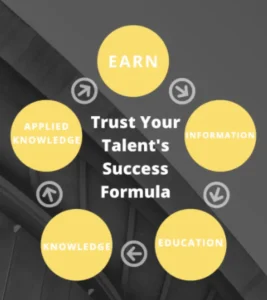
Bringing it all back, here’s a quick illustration of the “success formula” I created forTrust Your Talent Academy:
Information
Information is often times just facts about something — sometimes with more vivid descriptions of what’s happening. This is the starting point of the formula. As you can see, personally, I have nothing against it. I’m only concerned when most think that’s enough — especially when it comes to making investing decisions. If you are sensing my passion and amped up energy about this, I’m glad. This is the stage I was stuck at that caused my entire life savings to evaporate at the beginning of 2010. Imagine having just made some aspirational new year’s resolutions and personal goals to achieve just a few days ago, and learning that my hard earned (and “saved”) money vanished without a trace just like that?
Education
Now, education is usually information that has been interpreted and presented in a RELEVANT way to guide and increase the understanding level of whoever is receiving it. This is crucial because comprehension is key to maintaining a clear mind to process what’s to come. This is why we all hear the phrased “educated decision” these days. To me, it also speaks to personal accountability.
Knowledge
Then we get to the knowledge stage. This is when education has been internalized and has become integrated into our thought and decision-making process.
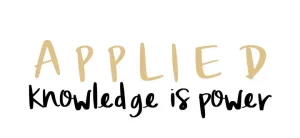
However, the old saying of “knowledge is power” is no longer the anthem people sing these days. There’s a new saying in town that rules now:
(Picture from Pinterest)
Or, to be more exact, what personal development guru, Dale Carnegie said:
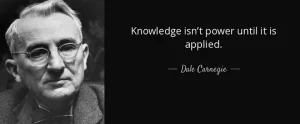
This is why I am unapologetically pro-mentorship. I like to say that knowledge and education are just the ingredients and the tools that we acquire. A mentor is the fire under the pot to help us get things cooking so that we can get to the last stage — EARN.
Some examples lately I’ve seen to illustrate this phenomenon of getting stuck at the stage of getting information look like these:
- I will just learn how to invest in multifamily buildings and see how it goes.
- I am already using the BRRRR Strategy (WARNING: BRRRR is not a strategy — please read this if you haven’t already).
- I am learning so much from this podcast and reading so-and-so’s books.
- I have a close friend (or cousin) who’s a realtor and he/she knows a lot and said they will help me buy my first/next investment property.
- I see that everyone is going to the US or Central America to look for properties, that’s probably where I should go next.
This list is funny (and is actually much longer) for 2 reasons — one: I could relate before being serious about my financial education, and two: it’s actually not mine. This list was passed down to me when I first got trained to be an educated investor. I can still hear the trainer’s voice saying:
I’m not knocking any of these behaviours. If you look closely, every one of them is still an action statement — that beats doing nothing. It’s just that “if you want something you’ve never had, you’ve got to do something you’ve never done”. Many are simply falling into the definition of insanity — “doing the same thing over the over again and expecting different results.” If books and tapes (now podcasts) made a difference, I’d expect to see more Rolls-Royce and Bentley pull up in front of bookstores and libraries. Getting investing club memberships is like paying for fancy country club memberships and was never properly trained on how to swing a club.”
In the last few years, I’ve seen people go from novice in one strategy to “coach” status in less than a year. Bought a couple of properties in the US and calling themselves experts in cross-border investors. Hiding behind power team members to elevate their credibility (genius marketing move, no doubt).
Intimes like this — for those who are experiencing their very first downturn or economic recession — learn to differentiate information vs those who truly want to educate you, share the knowledge with you and help you leverage their experiences. Better yet, seek beyond information and ask: what does it mean to me, my financial plans, my growth and my decision making process?
Before there’s any type of S.M.P. (make sure you read/review the S.M.P. Philosophy article), there are 2 more things that come before it: Why/Purpose and Goal (mostly financial in this case). I’m passionate about elevating financial literacy in all mankind. Real estate investing is simply a tool and real estate is only an asset class that we leverage to demonstrate the principles.
Tomy dedicated readers, I thank you for your support and feedback. If this is the first time you’re reading one of my publications, I hope you’ve enjoyed it and learned a thing or two.
For those of you who are ready and or curious about how to create your personalized financial success plan, you can visit theBootcamppageortalk to a Strategy Coachfrom Trust Your Talent Academy to learn more. Take action now if you’re serious about thriving through the tough times and come out better at the end of all of this!
If you’re wanting to be a part of a community of real estate investors from around the globe, here is theT.A.L.E.N.T.ed InvestorsFacebook Group. It’s a place where people come together to share experiences, knowledge, successes and challenges, and money making opportunities!
For those of you who prefer watching videos, here isthe YouTube channelwhere some of my work (very raw) has been shared.
Lastly, I just want to say thank you for your continuing support. I aim to be authentic and adding value to your life.
It’s ultimately about LIFE and I appreciate you coming on this journey with me!
(Written in Edmonton, AB)