
Tag: Financial Freedom

Financial Education: Real Estate Investing 101 — Mindset (Part 2)
March 22, 2022
My ears have been burning all week and I thank you for it. I thank you because I know you’ve done the work for yourself and that lots of emotions and energies were stirred up going through the given ‘homework’ from last week.
As human beings, we are ultimately largely controlled by our emotions first and foremost. Have you heard of the saying: people won’t remember exactly what you’ve done to them, but they’ll always remember how you’ve made them feel? It’s even MORE powerful when you’re the cause of your own emotions. And our why’s, our purposes and our self-identified value of existence become the BEST emotional anchor for why we do what we do. As kids, we asked the WHY questions all the time. As we grow up, we’ve learned to box ourselves in — thinking that the less ‘why’ questions we ask, the wiser we’ve become somehow. That, to me, has always been instinctually incomprehensible. I sincerely hope that you recognize that fact and share in the same perception moving forward to start questioning behaviours, facts and motives — especially those that come from ourselves. After all, I’ve been saying that adults are just kids with bills to pay.
Speaking of ‘bills to pay’, that’s now the trap.

This quote tends to hit home for many that I’ve encountered over the years especially if you’ve been in the work force for some time. That usually means that we’re getting to the roots of some of the old money mindset that’s no longer serving us. Most commonly — scarcity. That’s the idea that holds us back. And that idea could’ve been as easily created by hearing our parents complaining about not having enough money to pay the bill ONCE. ONCE! That’s how easy these fearful ideas and take roots. Hence, many of the examples given in Part 1 come from a place of “not having enough”. Yet, “not having enough” often times get translated into “not being enough” when our ego gets in the way. Remember, we are human BEINGS first and foremost. Stop letting materialistic possessions and century-old societal limitations tell you that you’re not enough. YOU ARE ENOUGH. It’s the simple idea that you believe in that statement that’s brought you here and made you read this.
WE ARE BORN ENOUGH. We just need to acquire better tools as we go through life to deal with different challenges that come our way. That — is the hard truth.
I often say to my students that, at the end of the day, what they’re learning (as I have and am doing my darnedest to pass down) is ultimately financial education. Financial education = how money works. Taking it one step further: investing = how money works itself to create more money. We simply choose to leverage real estate investing strategies as the main tool to demonstrate the principles here.
To quickly latching onto where we left off, here’s what you can do next: have your list in front of you. This list should now contain the new “altered reality/desired outcomes” you’d like to be living in. That’s now the new starting point. If you haven’t done it yet, do this now: DREAM out loud on every item on that list. I’ll give you a few examples:
- In 2 years, I would like to take my entire family to Disney World on a no-expense-spared vacation for the kids’ spring break. We’re going to stay at the Grand Floridian — Concierge level with VIP tickets to bypass lines for rides. We will also be doing their premium dining package so we don’t have to worry about going to Costco and Walmart to haul groceries back every other day. (I’m not paid for using Disney as an example. Full disclosure, I do have 4 Disney timeshare properties if you’re interested in chatting about that.)
- Next year (in 15 months), I want to be able to update our beater cars and have the cashflow from 2 properties cover the monthly payments.
- I would like to be able to donate $1,000/month to my favourite charity (this is where you come in and insert the name of your favourite charity) using my passive income.
- I would like to tell my boss to pound sand in exactly 30 months from today because I’ll have achieved financial freedom #2. If you need some support for what that means, you can watch this video and have a conversation with a Strategy Coach about how to get there. (Side note: this is important as many of our WHYs will evolve over time as we reach each new goal.)

- I want to be able to pay for my 3 kids’ university education while growing and preserving assets properly. (Less specific and nonetheless powerful.)
- I want to prove to many people that I didn’t fail school. The education system failed me and I’m right to follow my intuition and trust my own ability to create a better life for myself — one that doesn’t follow the typical path.
- I want to be able to go on a 12-month around-the-world cruise with my wife/husband and not have to worry about money.
- I want to support my parents in their old age.
As you witnessed here, some pictures are very vivid and deadline driven, and some are purely emotional. No right or wrong here (and you’ll hear me say that A LOT in almost everything I put out there.). The point is that you honour your true self. Notice how the last few statements all start with “I want”? Dig and dig deeper. Let it come from a place where it’s truly what you desire.
Here are also some guiding principles to help you (as they’ve helped me) further crystallize your picture:
- There may come a time in your pursuit for better financial wellness (aka — make more money and have more financial resources) where you experience a negative event or setback. (You will hear about how I lost $1M overnight in 2016 and went into negative net worth at a later time and how I made it back many times over in a short amount of time). The point is — this can be a common occurrence for most businesses. However, learning to adapt to these occasions will be key. Understand that these sorts of things happen and are to be expected is the first step. The second step NOW is to also realize WHY we do this mindset bit first. For example, people who want to get in better shape. If the fundamental purpose of getting in good shape is one that matter, one that — if not achieved — would be unbearable, unthinkable and completely undesirable. When that happens, they won’t let excuses such as: “well, I had to order something from the unhealthy menu when I was out with friends last weekend even though nothing on the menu would contribute to my goal.” Or, “I’ve been traveling for work non-stop for 3 weeks straight and there was just no time to exercise or look after what I was eating.” Or, “It was the holidays”, “I was on vacation”, “But I don’t have that much of it”, or “It made me happy at the time” (the most dangerous of it all). Frankly, exercise and diet is an easy target combo to demonstrate this point. And that point is PRIORITY. The sub-point here is DISCIPLINE.
A couple of my favourite quotes on these 2 words that I’ve heard (hard to pin point exactly who said them FIRST) that I’d like to share here:
PRIORITY — if it’s important to you, you’ll find a way. If not, you’ll find an excuse.
DISCIPLINE — it’s choosing what you want most over what you want now.
- We are not the first to leverage real estate investing to build a business. This fact alone should provide motivation, confidence and the belief that this can be done, and by you. The proof of concept has already been proven. The best example I can think of is Roger Bannister — the man who ran a mile in under 4 minutes when NOBODY thought it was humanly possible. The cool part about that is that, 6 weeks later, that record was broken by John Landy. I’m completely floored just by sharing the fact over and over again. And, while my name has not been printed all over mainstream media (and I’m happy to keep it that way), my personal dream is to help as many people achieve financial freedom as I have. If an immigrant from Taiwan moving to a completely foreign country with little to no English at 17 can eventually create financial freedom in 25 months and end up with a 8-digit net worth by simply following the footsteps of others before him, so can you. (This is only the 2nd time I have shared the net worth thing publicly to demonstrate 2 things: One — when done right, leveraging “real estate investing is never a get rich quick scheme, it’s a get rich for sure plan”. I have Ryan Carr on the Trust Your Talent Academy team to thank for that quote. Two — it’s utterly uncomfortable to share something like this. However, I’m asking you to be completely authentic with yourself as you journey through my articles, it would be unfair and simply hypocritical to dilute the truth or adapt the ‘lie by omission’ approach. It may continue to grow, it may not. It’s powerful knowing that it’s entirely up to me. I started wanting time and money freedom. It was never about chasing after a certain level of wealth. However, the happy side effect is the financial resources you’ll build. Either way, I’m not Elon Musk nor Jeff Bezos, or one of the Sharks or Dragons on TV, or maybe even one of your rich relatives. If that number inspires you, thank you. If it doesn’t, thank you. I’m still me.
- Most people’s reason behind getting started as an investor is to provide more time freedom in their lives — more time to spend with family and friends and less time spent in meaningless activities. Real estate investing can provide a path in which you get to choose how much time you spend working or being away from home. As I’m writing this, we’re living in peculiar times. Particularly talking about the end of COVID…that ‘forced’ us to spend a lot of time with our families. It’s one answer that I hear lots when I asked them “WHY do you want to learn how to invest in real estate?”. COVID proved that it’s not the amount of time we want to spend with our family, but the quality of the time we spend together that matters the most. I’ll just leave it at: quality over quantity still applies here and “quality” tends to come with a price tag.
With all that, here are the action items for this week on this subject:
- Create a dream board (or vision board). YES, I’m old school. This is where you get to go back in time and treat yourself like a 6th grader for a show and tell. Except that the only audience and the biggest fan of this project is YOU. Find images of your “desired outcomes” — in magazines, online, on Instagram, etc., and print them out and put the on the board. (Quick notes: you don’t have to fill the entire board right now if you don’t have enough. The purpose is to start getting you to visualize in a very real way. EVERY picture you put up there should at least bring a smile to your face, if not make you completely emotional and even break out into tears. That’s how powerful these images need to be!)
- Next, put a price tag and deadline next to each image. YES, this sounds crass to some of you. However, this is what we are dealing with here, aren’t we? Money is, after all, the most commonly used measurement and currency to exchange services and goods in the modern world. For example, if you’re wanting to take a family vacation (whatever the images you choose to use), do a guestimate or you can price everything out now online if you want to go the extra mile. I’ve had many students do that. Or — if you’d like to drive a certain car — go for a test drive, sit down with the sales person to discuss purchasing options and then bring that number back and put it on your vision board.
- Watch the videos suggested (link included here again) and speak to a Strategy Coach.
We will be wrapping up the ‘mindset’ portion after Part 3 and there will be lots more coming as we dive into more financial education content and leveraging real estate investing to help your dream board come true!

Financial Education through Real Estate Investing: Creative Financing — Seller Financing (Part 1)
August 9, 2022
(WARNING: EXPLICIT LANGUAGE)
The aspiration to be a professional real estate investor at the age 28 put me in a world of in-betweens:
- Had higher living standards compared to my student days from a good paying job yet lack actual resources to create momentum at building a real estate portfolio
- Acted like a professional but still looked young-ish and was often taken less seriously when raising capital and seeking joint venture partners
- Acquired the knowledge and yet was shy about asking people for any sort of real money (in the beginning)
This led me down a path that was challenging and yet incredibly rewarding later on. The path was short and filled with skills and experiences that continued to serve my journey as an investor today. That path is creative financing.
Thank you to your feedback and suggestions — this is the first ‘interactive’ topic that I’m taking on. Gladly 😃
Creative financing was one of the things that really put a smile on my face during my initial real estate investing Bootcamp back in 2010. Like many, one of my biggest worries was asking people for money. Better yet, it was “appearing like I was begging for money”. Let’s just call a spade a spade now first — the former worry is from lack of confidence, lack of experience and lack of data; the latter is just ego.
Today, I focus on helping the students at Trust Your Talent understand the essence of “money will follow good deals”. This means that, as professional real estate investors, our purpose is to find opportunities, analyze them, determine whether they are good and viable deals, and structure them into win-win situations (some strategies such as Lease Options can create win-win-win-win-win situations!).
Before going any further, I want to kick start by building some context and foundation for understanding:
- “Your exit strategies determine how you make money and how much money you make.” Every deal would typically involve 3 main phases — acquisition, holding and exit. The acquisition phase includes obtaining financing. This means, more frequently, seller financing happens at this stage more than any others.
- Seller financing is great and can be flexible when executed properly. This comes from knowing what it is and the different ways to leverage seller financing.
- Seller financing is also commonly known as vendor-take-back or VTB, or owner financing. They will be used interchangeable throughout to help you absorb and comprehend them better.
Seller financing is an umbrella term that includes several different types of “legal paperwork” to facilitate depending on the mutual solution the seller and buyer agree on:
- traditional (or some would call it typical) mortgage documents,
- option contracts,
- agreement for sale, etc.
To me, these are the 3 most commonly heard and used ways to leverage seller financing. The rest will simply be the different “instruments” or, as mentioned before, “legal paperwork” (I would be using air quotes if you could hear me talk about this in person) that you will use depending on the suggestions of your lawyer and/or the different names certain government authorities name them. For example, in parts of the US, VTB is facilitated as a “land contract sale”.
While the idea of leveraging seller financing is very exciting, it truly is not built for everyone. More importantly, it’s not built for every deal. As much as we all like the sound of putting little to no money down to acquire properties, keep in mind that professional investors are performance based investors still. If taking on a VTB is going to hurt the performance of your property tremendously, don’t do it. In Part 1 of the Cashflow Management articles, you’ll remember that seller financing will fall under the debt servicing portion of the equation — either adding to the primary cost of borrowing or be a complete replacement. Regardless, it’s debt.
Also, often times, seller financing tends to be pricier money than other sources of debt we can leverage. Note that I did say “often times” — meaning that there will be situations where it could be the opposite. We will look into that as this series continues.
Today, I simply want to provide some food for thought here between the pros and cons of seller financing. However, I do want to stress this first: this list is my opinion and is formed based on honest transactions. Malicious and ill-intentioned seller-financing scenarios will be addressed later on during story time (sad, I know…but good learning lessons!).
Pros for Seller—
- Potential tax advantages
- Quicker closing time
- Cashflow from debt repayment
- Flexible negotiation
Pros for Buyer —
- Little or no money in the deal initially — this means that if you have some money, you can potentially acquire more properties with the same pot of cash (SCALE!)
- Anyone can leverage it regardless of income, credit, downpayment and any other common and self-imposed limiting beliefs like experience, age, market, etc.
- Quicker closing time — avoid the lengthy application and assessment periods with institutional lenders (especially these days) who seem to want your first born as collateral
- Flexible terms — it’s all about the buyers and sellers aligning on each other needs and financial goals on these transactions
Cons for Seller —
- May cash out less or nothing at all upon the initial closing of the deal/transaction
- Less flexibility to exit the agreement should life circumstances change after the agreement has been executed by both parties
Cons for Buyer —
- Higher cost of borrowing as mentioned before — we often say that “we buy houses — cash or terms”. Seller financing falls under terms and can sometimes weakens the Buyer’s position to negotiate.
- May end up taking more time educating the seller on the benefits of VTB than going the traditional financing route (but it’s still worth it in the end most of the time I’ll say)
- Potentially higher closing costs especially on legal fees to structure it properly for both parties as buyers tend to be the one fronting the legal bills other than paying for the seller’s independent legal advice
Acouple of quick tips here for my fellow investors on using VTB:
- Whenever possible, offer VTB when you sell — unbelievable tax saving potential and cashflow. My perspective is this: I’ve put in the work to build, renovate, and maintain all my properties to a quality standard. When I’m selling, I’d like to continue to make money from it as much as possible because I’m not putting garbage properties on the market to sell. In other words, I back my own products. Plus, cashflow!
- Ask for a VTB with every offer. Yes, EVERY OFFER. It doesn’t matter how big or small the property or price tag is. This will often times provide some insight as to how motivated the seller is. If for nothing else, it plants the seed at the beginning of the negotiation process that may come in handy later. (Side note: I frankly call this an alignment process. The word ‘negotiation’ tends to have a yucky negative connotation attached to it.)
I’m wanting to share this because I’m seeing many amateurs getting half-ass trained on the idea of seller financing especially when the ‘downturn is happening’. The result is often the sellers getting hurt and us “investors” getting a bad reputation. Listen — no deals are perfect at all times. However, amateurs f*cking sellers over intentionally and accidentally are equally bad in my opinion.
Excited to continue with this series with everyone and I hope to continue to add value and get feedback from you!
Tomy dedicated readers, I thank you for your support and feedback. If this is the first time you’re reading one of my publications, I hope you’ve enjoyed it and learned a thing or two.
If you’re wanting to be a part of a community of real estate investors from around the globe, here is the T.A.L.E.N.T.ed Investors Facebook Group. It’s a place where people come together to share experiences, knowledge, successes and challenges, and money making opportunities!
For those of you who prefer watching videos, here is the YouTube channel where some of my work (very raw) has been shared.

If you prefer the live interaction and delivery to help you build some foundation, our next live in-person real estate investing Bootcamp is on September 24 and 25 in Toronto. Go ahead and speak to a Strategy Coach on how you can attend.
Lastly, I just want to say thank you for your continuing support.
I aim to be authentic and adding value to your life.
I invest to build a life. I build business to create better life experiences.
It’s ultimately about LIFE and I appreciate you coming on this journey with me!
(Written at the Four Points Windsor Hotel in Windsor, ON)

Financial Education through Real Estate Investing: Know the Difference — Information vs Education
October 11, 2022
(WARNING: EXPLICIT LANGUAGE INCLUDED)
This article is somewhat timely since we just had our Canadian Thanksgiving this past weekend. While painful, I am grateful that I got to experience this early and got the relentless reminder from my Mentor every step along the way. So…without sugar coating anything (and when have I ever if you’ve been following),this one is probably the BIGGEST small lesson on this journeyI want to share here.
It’s bigbecauseI’ve seen people get really hurt — financially, emotionally and mentally — from not being able to tell the difference of the two. Why? Because there are loud NOISES out there more than ever before — thanks to the prevalence of social media. An average person, an inexperienced person and someone who’s not even remotely educated get drowned out by the noises rather than trusting their own goals and instincts.
It’s small becauseall it takes is one small question to know the difference as one of my mentors hammered it into my head early on.
That question is simply this:what does it mean to me (relevance) and how does that aid in my decision-making process (personal accountability)?
Social media has created marketing monsters that prey on the weak and under-educated (or sometimes — completely uneducated) buyers. I’m grateful for the advice that I received years ago and yet have a hard time to pass it on at times without sounding overly preachy (side effect of being a teacher and mentor for a few years perhaps?!).
Why? Simply because, deep down, I believe that there’s good in all of us. For many, they are simply out there to make a living. However, with investing, does it make it ok when people get hurt and you are the cause of it? No. Even more, is it ok that you simply walk away because you have the best asset protection structure? Fuck no!
We live in the information age — that should not be a shock or secret anymore at this point. The speed at which we can obtain and consume information is astounding (and frankly, frightening). Information isn’t always ‘good’. Just like not all food is created equal, neither is information.An average person today — voluntarily and involuntarily — is exposed to and consumes more information in a day than our ancestors in their entire lifetime even just 300 years ago.Yet, many amateur investors or investor wanna-bes turn to fun videos and well-designed Instagram posts for advice as their first and only stop.
Okay, I know you’re here to get something more concrete than what you may have already known. I simply just wanted to make a point first about the symptoms that I’ve witnessed over the last decade here. Please do understand that I hold social media in a very fond way in my own life. It’s the main way that’s helped me stay connected with friends and family all over the world as an immigrant and traveling entrepreneur.
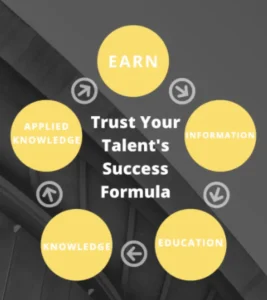
Bringing it all back, here’s a quick illustration of the “success formula” I created forTrust Your Talent Academy:
Information
Information is often times just facts about something — sometimes with more vivid descriptions of what’s happening. This is the starting point of the formula. As you can see, personally, I have nothing against it. I’m only concerned when most think that’s enough — especially when it comes to making investing decisions. If you are sensing my passion and amped up energy about this, I’m glad. This is the stage I was stuck at that caused my entire life savings to evaporate at the beginning of 2010. Imagine having just made some aspirational new year’s resolutions and personal goals to achieve just a few days ago, and learning that my hard earned (and “saved”) money vanished without a trace just like that?
Education
Now, education is usually information that has been interpreted and presented in a RELEVANT way to guide and increase the understanding level of whoever is receiving it. This is crucial because comprehension is key to maintaining a clear mind to process what’s to come. This is why we all hear the phrased “educated decision” these days. To me, it also speaks to personal accountability.
Knowledge
Then we get to the knowledge stage. This is when education has been internalized and has become integrated into our thought and decision-making process.
However, the old saying of “knowledge is power” is no longer the anthem people sing these days. There’s a new saying in town that rules now:
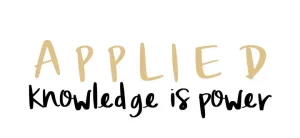
(Picture from Pinterest)
Or, to be more exact, what personal development guru, Dale Carnegie said:

This is why I am unapologetically pro-mentorship. I like to say that knowledge and education are just the ingredients and the tools that we acquire. A mentor is the fire under the pot to help us get things cooking so that we can get to the last stage — EARN.
Some examples lately I’ve seen to illustrate this phenomenon of getting stuck at the stage of getting information look like these:
- I will just learn how to invest in multifamily buildings and see how it goes.
- I am already using the BRRRR Strategy (WARNING: BRRRR is not a strategy — please read this if you haven’t already).
- I am learning so much from this podcast and reading so-and-so’s books.
- I have a close friend (or cousin) who’s a realtor and he/she knows a lot and said they will help me buy my first/next investment property.
- I see that everyone is going to the US or Central America to look for properties, that’s probably where I should go next.
This list is funny (and is actually much longer) for 2 reasons — one: I could relate before being serious about my financial education, and two: it’s actually not mine. This list was passed down to me when I first got trained to be an educated investor. I can still hear the trainer’s voice saying:
I’m not knocking any of these behaviours. If you look closely, every one of them is still an action statement — that beats doing nothing. It’s just that “if you want something you’ve never had, you’ve got to do something you’ve never done”. Many are simply falling into the definition of insanity — “doing the same thing over the over again and expecting different results.” If books and tapes (now podcasts) made a difference, I’d expect to see more Rolls-Royce and Bentley pull up in front of bookstores and libraries. Getting investing club memberships is like paying for fancy country club memberships and was never properly trained on how to swing a club.”
In the last few years, I’ve seen people go from novice in one strategy to “coach” status in less than a year. Bought a couple of properties in the US and calling themselves experts in cross-border investors. Hiding behind power team members to elevate their credibility (genius marketing move, no doubt).
Intimes like this — for those who are experiencing their very first downturn or economic recession — learn to differentiate information vs those who truly want to educate you, share the knowledge with you and help you leverage their experiences. Better yet, seek beyond information and ask: what does it mean to me, my financial plans, my growth and my decision making process?
Before there’s any type of S.M.P. (make sure you read/review the S.M.P. Philosophy article), there are 2 more things that come before it: Why/Purpose and Goal (mostly financial in this case). I’m passionate about elevating financial literacy in all mankind. Real estate investing is simply a tool and real estate is only an asset class that we leverage to demonstrate the principles.
Tomy dedicated readers, I thank you for your support and feedback. If this is the first time you’re reading one of my publications, I hope you’ve enjoyed it and learned a thing or two.
For those of you who are ready and or curious about how to create your personalized financial success plan, you can visit theBootcamppageortalk to a Strategy Coachfrom Trust Your Talent Academy to learn more. Take action now if you’re serious about thriving through the tough times and come out better at the end of all of this!

If you’re wanting to be a part of a community of real estate investors from around the globe, here is theT.A.L.E.N.T.ed InvestorsFacebook Group. It’s a place where people come together to share experiences, knowledge, successes and challenges, and money making opportunities!
For those of you who prefer watching videos, here isthe YouTube channelwhere some of my work (very raw) has been shared.
Lastly, I just want to say thank you for your continuing support. I aim to be authentic and adding value to your life.
It’s ultimately about LIFE and I appreciate you coming on this journey with me!
(Written in Edmonton, AB)