
Tag: #investing
Financial Education: Know the Difference — Cash on Cash Return vs Return on Investment
May 3, 2022
Imust confess. To this day, I still have a hard time walking into a Walmart , any Walmart— for a few different reasons. One of them is knowing that most of these greeters don’t ‘choose’ to work. They still have to work and most of them are seniors. In the rare times that I do, for some weird reason, I have Warren Buffett talking in my ear: “if you don’t find a way to make money while you sleep, you will work until the day you die.” Truthfully, I don’t have any qualms about the latter part as long as I love doing what I love every single day. Even if it’s considered work.
Learning how to invest and financial education has been an incredibly fun and rewarding journey so far. And I’m still learning everyday. It’s almost as if the more I learn, the less I know. And for a while now, that’s ok. I’m no longer worried about not getting 100% at a test and getting scolded. Or, worse yet, getting questioned on how much effort I’ve put into my work. I know that , if I’ve given what I want to do 100% of everything I got right now, I’m ok with the outcome — whatever it may be. If the outcome is not ideal, it simply means that I need an adjustment or improvement somewhere. In mindset, in knowledge level or in my skill level.
What does that have anything to do with this topic, you ask? Simple. And here’s the thought process:
- Most of us have the tendency to work harder when we want ‘more’. More money to be specifically.
- Investing is learning how money works for itself.
- Many people and ‘investors’ (I will use that term loosely here), once they acquire a property, it’s like set and forget. It’s likely one of the worse things to do as an educated investor.
- The calculations of ‘returns’ on investment deals is an important process. And the numbers represents how hard our money is working for us.
If we are willing to work hard, why wouldn’t we make sure our money works harder than us?
The answer to this question, as I’ve witnessed over the years, has separated people who just added long-term wealth (through inflation mostly) and people who achieve sustainable financial freedom.
Many ‘investors’ and sales people in the financial planning industries seem to use these terms incorrectly and interchangeably. Understanding the difference between the two terms have helped me in making buying and selling decisions of real estate investment deals more effectively and efficiently. After all, it’s all about making sure our money is working hard(er) for us so we can free up more time and energy (and money) to pursue the things we really want to do.
What is Cash on Cash Return (CoC)
Dictionary.com defines cash-on-cash return as…wait, wait, wait! Don’t go yet. I’m just kidding! Like a Best Man’s speech that nobody wants to listen to, I’m not about to take that approach…yet. However, acknowledging that I’t know everything, I may have borrow some definitions from time to time to prove a point.
I will say this though: my favourite ‘dictionary’ these days is www.Investopedia.com when I learn a new term related to investing or money. So, guess what, Investopedia defines “A cash-on-cash return [as] a rate of return often used in real estate transactions that calculates the cash income earned on the cash invested in a property.” It would be good to note that this refers to pre-tax income.
However, the way I learned it is simply this: the CoC is basically like the interest rate you earn. For example: if the bank is promising you 2% a year (year right 😅…) on your money in a savings account. Your CoC is 2%. Of course, if we were to get a bit more technical, then this typically would refer to simple interest.
As a result, CoC is commonly used in any sort of income properties — single family, multi-unit residential, commercial, serviced accommodations, etc. In addition, many private lending deals are dealt in simple interest so the interest rate offered by the lender (or borrower) is a directly CoC return — not counting any additional fees the lenders may impose.
CoC is a straightforward and simple measuring stick for us to know how hard our money is working for us on an annual basis. This really should serve as an indicator for investors who understands fundamentally how to leverage real estate as an investment tool. When the CoC goes down (and it typically does) to a certain point, it may be time to ‘trade up’. At this point, there’s usually some equity built up as well.
What is Return on Investment (ROI)
On the other hand, ROI is a way to measure the overall investment performance when there’s a clear start and a clear end. To compare apples to apples and borrowing Investopedia’s definition: Return on investment (ROI) is a performance measure used to evaluate the efficiency or profitability of an investment or compare the efficiency of a number of different investments.
As a result, ROI is typically tied directly with strategies like Flips and Lease Options. These strategies are known to have clear start and end dates.
Just like not all deals and not all strategies are created equally, these two terms also aren’t. They exist for a reason. To me, the reason is to support us in making better and faster decisions when searching for and comparing deals at hand.
The lesson here remains: real estate is just our vehicle in investing. The goal is to create better financial resources and blueprints for ourselves, and hopefully generations to come. Making sure our money is working hard for us at all time is, in my opinion, the highest level of the art of investing.
If you’re intrigued by this article, I would also suggest a topic for you to dig deeper into also: the velocity of money. You can read up on it or watch videos.
Tomy dedicated readers, I thank you for your support and feedback. If this is the first time you’re reading one of my publications, I hope you’ve enjoyed it and learned a thing or two.
For those of you who prefer watching videos, here is the YouTube channel where some of my work (very raw) has been shared.

(Written at home in Edmonton, AB)
Financial Education through Real Estate Investing: Creative Financing — Seller Financing through AFS (Part 5)
September 6, 2022
What the A the F the S?!
Upon first glance, it seems like a new tool but it actually isn’t. Often times, when you use the acronym of AFS — Agreement for Sale — with people that are not educated nor active in the real estate transaction world, they will think it stands for a simple purchase agreement.
Well, they’s got that part right! The biggest difference is that an AFS — Agreement for Sale — (I’m just going to use AFS from now on so the word count doesn’t get fudged here) permits the Buyer to have a longer than usual closing period.
First thing first, this particular way of structuring a deal falls under the same premise that the Seller and Buyer align on a fundamental level like the ones previously discussed and illustrated: neither are in need of a quick (or standard) closing timeline. This is simply another way to obtain seller financing for buyers who may be able to leverage it to create win-win situations for both parties.
Again, I want to emphasize this: just because creative financing sounds cool and obtaining seller financing makes an investor sound smarter than usual does NOT mean seller financing is a fit in every situation and every deal.
Before going any further, I want to share this quick comparison chart to differentiate the 3 ways to leverage seller financing so far:

In the next article, we will look at the complete comparison so you can get the complete view of the differences. This way, we can just focus on AFS today.
As both a buyer and a seller in different situations, I have to admit: AFS is my least favourite form of seller financing. However, it’s not without its merits.
Let me share my very first AFS “deal” with you. Spoiler alert: I was neither the buyer nor the seller in this case!
An Unusual Compensation
Picture it: Edmonton, May 2012 (Yes…still watching the Golden Girls…). On a not particularly eventful day, I got a call from a commercial realtor that I had the chance of sharing my baby strategy (Lease Options) once at a networking event. He began to share with me that he has a client wanting to sell his 7-bay industrial property just outside of Edmonton (Alberta). This client of his also found out that one of his tenants that runs a auto body shop business wants to buy it but does not have the liquid cash to execute on it.
The realtor thought of me apparently because of how excited and passionate I was when I shared with everyone at that networking event about how creative financing is helping a 30-year old exit a 6-figure corporate job soon. And sure enough, 2 months after that, I declared Financial Freedom #1. The date was July 25, 2012. You will never forget the day you declare financial freedom.
Alright, back to the story…
This is literally how I remember parts of how that conversation went:
Realtor: Yeah…I recall you mentioning that you can help people buy properties with little to no money down?
Me: Well…yes (not knowing exactly what he was looking for yet).
Realtor: Well, I got this situation here that I’m hoping you can help with. And I don’t know how you’ll be paid but I trust you’ll figure that out.
Me: Sure. Happy to help! What’s the ‘situation’?
Look, the premise is simple here:
- Seller wants to sell and is not in a huge rush
- Buyer wants to buy and is lacking the financial means right now
There’s alignment! All I ended up doing is educating both the buyer and seller on VTB and figuring out which method is the best for both parties.
At the end of it all, we landed on using AFS and that was an ah-ha moment for me as well since I’ve been partial towards Lease with the Options to Purchase up to this point.
The Buyer was committed! He had a whole business plan about:
- How he was going to expand his business over the next 3 years taking up all 7 out of the 7 bays,
- How he was going to build more bays to rent it out once he takes up all 7 existing bays,
- How he had been waiting for an opportunity like this since he was a little boy and learning how to ‘tinker’ with his Dad’s Oldsmobile (THAT got to me and the Seller)
So, here’s the big ah-ha I took away and continue to apply today: when I know for sure that I want to acquire a specific property but lack the complete financial resources to satisfy traditional lending, I will use AFS. This means that — on a scale of 1 to 10 (10 being the highest) — I want this property at a level 10. Although, to be completely honest, these days I do have the privilege to gather my resources necessary to close on most deals having spent over a decade building up a reputation within the industry. Regardless, it’s a lesson that I will never lose and always share.
For those of you who are wondering exactly how this all got put together, here’s your favourite part:
- A 5-year long AFS was created by a lawyer after an initial Letter of Intent to align the Buyer and the Seller’s goals (bonus: with the option to extend another 2 years if the Seller needed it)
- The Seller agreed to a symbolic downpayment and offered a competitive interest rate for the balance
- The Seller’s main focus was the monthly cashflow (income from the Buyer’s monthly payment) as he was a retiring landlord
- The Buyer successfully grew his auto body shop business and business income as planned
- In fact, Buyer was ahead of schedule by almost 2 years but chose to continue to stay in the original agreement for the full 5-year term as a thank-you to the Seller so that the income would continue for him
- The Seller was happy with 60 payments during the AFS and happily walked away with a lump sum when the Buyer made the balloon payment at the end (did I mention the tax advantages the Seller got out of this deal? No? Well…I’ll have to share that next!)
- The Buyer paid for the Realtor’s commissions for the ‘Sale’ as part of the Agreement with the Seller
For me, the Buyer also wanted to pay me for my ‘knowledge and expertise’ and I refused. This was one of the BEST EXPERIENCES I have ever had as a real estate investor leading up this point. Little did I know that this passion to educate opened up another door for me 2 years later when I began to train and mentor others globally since 2014.
In the end, I did get a huge gift card from the Realtor. Huge enough that I could buy a brand new Dyson vacuum with it. Yes, I enjoy cleaning and love a good vacuum.
So, here you have it. While AFS is not my favourite from a technical standpoint, it has its way of making a deal work. As mentioned (and kind of like everything else in life these days), when I really want a property, I will use AFS as my acquisition strategy.
At this junction, I truly do hope that you are also starting to see the power of financial education. It has nothing to do with the ‘investment type’ or ‘asset class’ that matters. It has everything to do with your level of financial literacy.

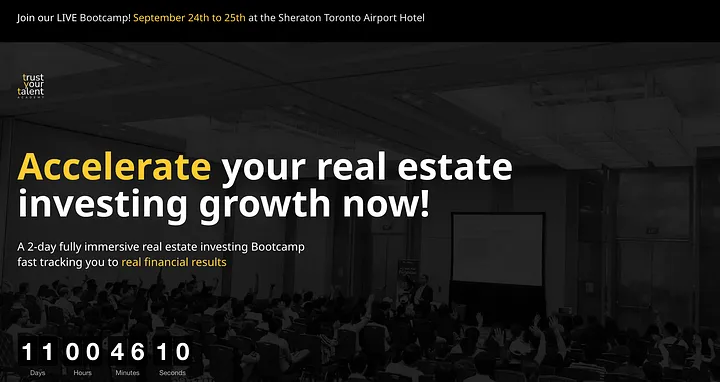
For those of you who are in and close to Toronto, ON — Trust Your Talent is running a 2-day LIVE IN-PERSON Real Estate Investing Bootcamp on September 24 & 25 where you will dig into this particular strategy amongst many others. You can visit the Bootcamp Registration page or talk to a Strategy Coach from Trust Your Talent Academy to learn more.

Tomy dedicated readers, I thank you for your support and feedback. If this is the first time you’re reading one of my publications, I hope you’ve enjoyed it and learned a thing or two. If so, please share a clap here!
If you’re wanting to be a part of a community of active real estate investors from around the globe, here is the T.A.L.E.N.T.ed Investors Facebook Group. It’s a place where people come together to share experiences, knowledge, successes and challenges, and money making opportunities!
For those of you who prefer watching videos, here is the YouTube channel where some of my work (very raw) has been shared.

Lastly, I just want to say thank you for your continuing support. I aim to be authentic and adding value to your life.
It’s ultimately about LIFE and I appreciate you coming on this journey with me!
(Written at home in Edmonton, AB)

Financial Education through Real Estate Investing: Know the Difference — Information vs Education
October 11, 2022
(WARNING: EXPLICIT LANGUAGE INCLUDED)
This article is somewhat timely since we just had our Canadian Thanksgiving this past weekend. While painful, I am grateful that I got to experience this early and got the relentless reminder from my Mentor every step along the way. So…without sugar coating anything (and when have I ever if you’ve been following),this one is probably the BIGGEST small lesson on this journeyI want to share here.
It’s bigbecauseI’ve seen people get really hurt — financially, emotionally and mentally — from not being able to tell the difference of the two. Why? Because there are loud NOISES out there more than ever before — thanks to the prevalence of social media. An average person, an inexperienced person and someone who’s not even remotely educated get drowned out by the noises rather than trusting their own goals and instincts.
It’s small becauseall it takes is one small question to know the difference as one of my mentors hammered it into my head early on.
That question is simply this:what does it mean to me (relevance) and how does that aid in my decision-making process (personal accountability)?
Social media has created marketing monsters that prey on the weak and under-educated (or sometimes — completely uneducated) buyers. I’m grateful for the advice that I received years ago and yet have a hard time to pass it on at times without sounding overly preachy (side effect of being a teacher and mentor for a few years perhaps?!).
Why? Simply because, deep down, I believe that there’s good in all of us. For many, they are simply out there to make a living. However, with investing, does it make it ok when people get hurt and you are the cause of it? No. Even more, is it ok that you simply walk away because you have the best asset protection structure? Fuck no!
We live in the information age — that should not be a shock or secret anymore at this point. The speed at which we can obtain and consume information is astounding (and frankly, frightening). Information isn’t always ‘good’. Just like not all food is created equal, neither is information.An average person today — voluntarily and involuntarily — is exposed to and consumes more information in a day than our ancestors in their entire lifetime even just 300 years ago.Yet, many amateur investors or investor wanna-bes turn to fun videos and well-designed Instagram posts for advice as their first and only stop.
Okay, I know you’re here to get something more concrete than what you may have already known. I simply just wanted to make a point first about the symptoms that I’ve witnessed over the last decade here. Please do understand that I hold social media in a very fond way in my own life. It’s the main way that’s helped me stay connected with friends and family all over the world as an immigrant and traveling entrepreneur.
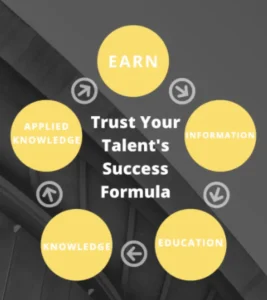
Bringing it all back, here’s a quick illustration of the “success formula” I created forTrust Your Talent Academy:
Information
Information is often times just facts about something — sometimes with more vivid descriptions of what’s happening. This is the starting point of the formula. As you can see, personally, I have nothing against it. I’m only concerned when most think that’s enough — especially when it comes to making investing decisions. If you are sensing my passion and amped up energy about this, I’m glad. This is the stage I was stuck at that caused my entire life savings to evaporate at the beginning of 2010. Imagine having just made some aspirational new year’s resolutions and personal goals to achieve just a few days ago, and learning that my hard earned (and “saved”) money vanished without a trace just like that?
Education
Now, education is usually information that has been interpreted and presented in a RELEVANT way to guide and increase the understanding level of whoever is receiving it. This is crucial because comprehension is key to maintaining a clear mind to process what’s to come. This is why we all hear the phrased “educated decision” these days. To me, it also speaks to personal accountability.
Knowledge
Then we get to the knowledge stage. This is when education has been internalized and has become integrated into our thought and decision-making process.
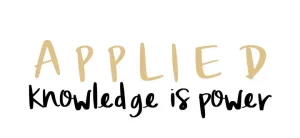
However, the old saying of “knowledge is power” is no longer the anthem people sing these days. There’s a new saying in town that rules now:
(Picture from Pinterest)
Or, to be more exact, what personal development guru, Dale Carnegie said:
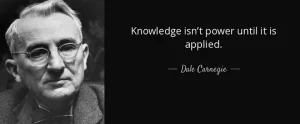
This is why I am unapologetically pro-mentorship. I like to say that knowledge and education are just the ingredients and the tools that we acquire. A mentor is the fire under the pot to help us get things cooking so that we can get to the last stage — EARN.
Some examples lately I’ve seen to illustrate this phenomenon of getting stuck at the stage of getting information look like these:
- I will just learn how to invest in multifamily buildings and see how it goes.
- I am already using the BRRRR Strategy (WARNING: BRRRR is not a strategy — please read this if you haven’t already).
- I am learning so much from this podcast and reading so-and-so’s books.
- I have a close friend (or cousin) who’s a realtor and he/she knows a lot and said they will help me buy my first/next investment property.
- I see that everyone is going to the US or Central America to look for properties, that’s probably where I should go next.
This list is funny (and is actually much longer) for 2 reasons — one: I could relate before being serious about my financial education, and two: it’s actually not mine. This list was passed down to me when I first got trained to be an educated investor. I can still hear the trainer’s voice saying:
I’m not knocking any of these behaviours. If you look closely, every one of them is still an action statement — that beats doing nothing. It’s just that “if you want something you’ve never had, you’ve got to do something you’ve never done”. Many are simply falling into the definition of insanity — “doing the same thing over the over again and expecting different results.” If books and tapes (now podcasts) made a difference, I’d expect to see more Rolls-Royce and Bentley pull up in front of bookstores and libraries. Getting investing club memberships is like paying for fancy country club memberships and was never properly trained on how to swing a club.”
In the last few years, I’ve seen people go from novice in one strategy to “coach” status in less than a year. Bought a couple of properties in the US and calling themselves experts in cross-border investors. Hiding behind power team members to elevate their credibility (genius marketing move, no doubt).
Intimes like this — for those who are experiencing their very first downturn or economic recession — learn to differentiate information vs those who truly want to educate you, share the knowledge with you and help you leverage their experiences. Better yet, seek beyond information and ask: what does it mean to me, my financial plans, my growth and my decision making process?
Before there’s any type of S.M.P. (make sure you read/review the S.M.P. Philosophy article), there are 2 more things that come before it: Why/Purpose and Goal (mostly financial in this case). I’m passionate about elevating financial literacy in all mankind. Real estate investing is simply a tool and real estate is only an asset class that we leverage to demonstrate the principles.
Tomy dedicated readers, I thank you for your support and feedback. If this is the first time you’re reading one of my publications, I hope you’ve enjoyed it and learned a thing or two.
For those of you who are ready and or curious about how to create your personalized financial success plan, you can visit theBootcamppageortalk to a Strategy Coachfrom Trust Your Talent Academy to learn more. Take action now if you’re serious about thriving through the tough times and come out better at the end of all of this!
If you’re wanting to be a part of a community of real estate investors from around the globe, here is theT.A.L.E.N.T.ed InvestorsFacebook Group. It’s a place where people come together to share experiences, knowledge, successes and challenges, and money making opportunities!
For those of you who prefer watching videos, here isthe YouTube channelwhere some of my work (very raw) has been shared.
Lastly, I just want to say thank you for your continuing support. I aim to be authentic and adding value to your life.
It’s ultimately about LIFE and I appreciate you coming on this journey with me!
(Written in Edmonton, AB)