

Financial Education through Real Estate Investing: Recession & Cashflow Management (Part 2)
July 26, 2022
Have you ever felt financially desperate or hopeless, or both?
Don’t get me wrong. I did not come from most people’s class definition of a poor family. In fact, at one point in my life (between the age of 5–11), I had great creature comforts and then some. Dad’s government job was stable and Mom’s manufacturing business was growing. If you’re looking for a rags to riches story, I probably don’t fit that box. However, I do describe my upbringing as hopelessly middle class (if not lower middle-class).
There is absolutely no disrespect to my parents. I know they did their best given the upbringing they had. However, I also know that I wanted to break that mold. I had to — if I wanted something different. Something more. After all, my Mom’s the one that always said: the next generation should do better.
Many have asked me how I learned everything I’ve learned over the years, I usually paint them this picture:
- Just moved from Vancouver to Edmonton in 2009 as a bright-eyed 27 year-old wanting to climb that corporate ladder. I was willing to suffer through being lonely again leaving my close friends in search for a better future. After all, what’s hard work and sacrifice? Aren’t those the bare minimum requirement for success?
- After some consistent 80-hour weeks for months at my job, I was further beat down by opening my “investment statements” — mentally and emotionally — on a weekly basis.
- Feeling smart, I asked a co-worker (who is my mother’s age) how she manages her money as she looks to be doing pretty well — a beautiful house, amazing (not to mention constant) vacations and multiple luxury cars — all the while forgetting that she’s twice my age and has had way more time to accumulate her wealth. Regardless, I was connected to her ‘guy’. This was the guy that represented the developer that later on took every last penny of my hard earned money away from me — among many others. (Side note: this is why one of my favourite quotes is “Don’t compare your chapter 1 to someone else’s chapter 30.”)
- Feeling deflated, stressed, cheated and angry, I went to this meeting at a law firm with people in their 50’s, 60’s, 70’s…and maybe even 80’s. The scene I witnessed still shocks me to my very core every time I picture it. Imagine seeing people who are your parents’ and grandparents’ age — in a public space and they are just yelling, howling, crying and screaming. Nobody was able to get a full sentence out other than the lawyer representing us. The collective us that had our money ‘stolen’ in broad daylight. The collective us that thought: real estate is much safer than stocks and mutual funds. Since most of us already took giant losses and nobody knew if they would see their retirement funds bounce back, we all thought we were being smart cutting our losses and redirecting our money into real estate.
- Now imagine this: your parents and grandparents saying things like: “How am I going to live?” “How am I going to pay rent and put food on the table?” “I’m too old to go back to work.” “That was my entire life’s work.” Are you feeling what I’m feeling now?
Instead of feeling hopeful like I was potentially going to get my money back, I walked away from it feeling shook and completely numbed.
The reality slowly woke me as I auto-piloted myself home after that brief and emotionally disturbing meeting. Here I am —
- Been in the workforce for 3 years,
- Making a 6-figure income year after year,
- Living in a nice house,
- Driving a Mercedes,
- Having a rental condo back in Vancouver.
All the labels that should’ve been considered as success markers meant nothing. Because, the truth was this —
- I was having “Ramen Mondays” and “Deep Fried Fridays” to save money on food. When I first moved into this beautiful new home that’s 3 times the size of my Vancouver condo, I did not know all the surprise expenses that would pretty much incur immediately. Here’s a picture of our living room, dining room, media room, office space and storage:

Those are towel-covered moving boxes.
- I was using Future Shop (if you remember them) flyers and any flyers I could get as window coverings. Forget about buying new furniture or anything else other than the bare essentials.
- I was feeding into my Vancouver condo. This, I later learned is also called “paying my tenant to live in my property”. It was further draining my income.
- I was worth more dead than alive. With a lousy life insurance policy that came with my work benefits plan (always had a hard time finding life insurance for me due to my health conditions) and the recent ‘loss of money’, I was in negative net worth. In other words: I. WAS. BROKE.
That made me doubt everything I believed in — is working hard alone enough? Is having a high income job enough? Is having a corporate ladder to climb enough?
That made me question my choice to move away from my friends — my support network. Was the sacrifice worth it?
And, something happened.
Weeks later, on my drive to work one day, I heard about a financial education seminar. I perked up. Turning the volume a bit louder, I heard that it was about real estate investing. I was hooked.
That was January 2010.
As of today, I’ve been broke twice, literally. And those experiences are the fuel for these articles.
Of course, there are more layers as to why I continue to build cashflow and wealth through real estate (and yes, there are days that I get tired of the idea of the process of buying another property). However, it’s now time to share some lessons first. Lessons from both times when I was ‘broke’.
For starters, recognizing that our behaviour during a personal financial recession is usually the same behaviour we exhibit during an external financial recession.
Lessons from the 1st Negative Net Worth
- Learn how to identify deals and calculate risks myself. You don’t know what you don’t know.
- Find ways to make money when I sleep. You don’t know what you don’t know.
- Create multiple income streams.
- My financial well being is 100% my own responsibility and no on else’s.
- Live largely yet frugally. Buy assets first and leverage assets to fund my liabilities.
Lessons from the 2nd Negative Net Worth
- Get to Financial Freedom #2 (refer to previous article) first before taking on more risk.
- As long as I stay above Financial Freedom #2, I’m ok to refi (after the BRRRR process) and let a few of properties in my portfolio go into negative cashflow with the plan to scale up. IMPORTANT concept here: despite what most people might think, not every Starbucks, Safeway or Exxon is profitable. However, as an overall corporation, they are.
- Leverage the funds to acquire new performing assets, or feed into portfolio income (aka park it), or simply keep as contingency funds depending on the larger economic conditions.
The lessons got bigger.
Surprisingly, I also find these lessons very applicable and relevant to what most investors are going through these days — new and seasoned.
I have been speaking with many “investors” over the last couple of months who are looking for guidance and support. If there’s anything I can do to help, feel free to request for a call with me. I know that my team is also happy to support in any way they can as well.
Tomy dedicated readers, I thank you for your support and feedback. If this is the first time you’re reading one of my publications, I hope you’ve enjoyed it and learned a thing or two.
If you’re wanting to be a part of a community of real estate investors from around the globe, here is the T.A.L.E.N.T.ed Investors Facebook Group. It’s a place where people come together to share experiences, knowledge, successes and challenges, and money making opportunities!
For those of you who prefer watching videos, here is the YouTube channel where some of my work (very raw) has been shared.

If you prefer the live interaction and delivery to help you build some foundation, our next live in-person real estate investing Bootcamp is on September 24 and 25 in Toronto. Go ahead and speak to a Strategy Coach on how you can attend.
Lastly, I just want to say thank you for your continuing support.
I aim to be authentic and adding value to your life.
I invest to build a life. I build business to create better life experiences.
It’s ultimately about LIFE and I appreciate you coming on this journey with me!
(Written at home in Edmonton, AB)

Financial Education through Real Estate Investing: Know the Difference — How to Spot an Amateur vs a Professional (Part 2)
August 2, 2022
Times like this right now are even more crucial to make sure that nobody falls into any traps set by desperate and hand-to-mouth “professionals”. These are lessons that were passed down to me by my Mentors along the way and — as usual — some of them I had to learn the hard way because I didn’t listen.
Before we go any further, I want to thank everyone who reached out to share that you could relate to some of my journey (especially the ones shared in the last article). My story may not be the most extraordinary (and it doesn’t have to be), as long as I’m making a difference in the world by sharing it, I’ve fulfilled my purpose here.
Some of you have also reached out to say that I seem to have gotten a little ‘too real’ here and there in the last few articles. Well, I don’t know what to tell ya other than a) I write like I talk, b) I’m looking to share authentically and c) I’m definitely lying if I tell you it’s all going to be rainbows and butterflies if you just get financially educated. That’s like saying “if you just go to school and get academically educated, the rest of your life is set”.
Often times, one of the first things I ask for when I get to share publicly is this: do you want me to tell you what you need to hear or what you want to hear? Almost in unison, it would be “what you need to hear” every time. Look — I’m not here to burst anyone’s bubble and I’m certainly not perfect, and I’m definitely here to share enough of my learnings with you so that you get to bypass some or most of the mistakes that I have made. The mistakes that have cost me millions (literally), sleepless nights, gallons of tears and sweat, and occasional yet severe self doubts about my ability to succeed at all.
Part 1 of this topic was better received that I could have ever imagined. I remember watching one of Robert Kiyosaki’s interviews. He said: “Overnight, I became the most hated man amongst all real estate agents in America because I’m telling people that your house is not your biggest asset, it’s your biggest liability.” These days, I can completely relate to that feeling. The truth when it comes to investing and money can often be unsettling, unwelcoming, unpopular and ill-received by many. Call me dumb, call me passionate, call me anything you want — but that’s the fuel for Part 2 of this same topic.
So, here we go again. And today, we’re only going to focus on ONE thing:
Using “Raising Capital” as a Marketing tool or Part of a Tag Line
This one is arguably the most used ‘phrase’ amongst the least educated. Or, worse yet — those with ulterior motives.
Before some of you bite my head off here, I’ll be the first to admit that “raising capital” is a legitimate activity, skill and business process not only for real estate investors, but for all entrepreneurs.
1. “Raising Capital” as a Marketing Tool
Strictly speaking about real estate investing, needing access to capital is the one topic that newbies dread and are often frightened by the most. The reality is: if the deal is good, the money will follow. Amongst all the Trainers and Mentors are Trust Your Talent, we always say to our students that “one day, you’ll have more money than you have deals.” Nobody initially believes us. Nobody. Then months and a couple of short years go by, one by one, they would come back and say things like: “I have money investors lining up and I have no deals!”
Let’s unpack that quickly here.
It’s not that there are no deals. It’s the fact that we’ve learned better as we do more deals and have gathered more experiences. We’ve simply tightened our business process, tweaked our investment criteria and goals along the way. As a result, elevated the demand of our deal quality over time.
I’ve also been saying to my students lots over the years: “if your first deal is your best one, you’re doing it wrong”. Again, if you know me, you know I love my grey area and seldom use words like right or wrong. I generally prefer “good or bad”, and “better or worse” in any situation.
Circling back to why this is seen as an amateur move is simply because of these reasons:
- Especially for newbies, knowledge and experience count first and foremost. I can be biased because I attribute any of my current financial success to the financial education that I got and applied over the years. It’s like most of us fresh out of school and applying for our first ‘real’ job in the world. It’s the classic paradox — you need to work to get experience and you also need experience to get work. When that’s not the case, the shortcut is typically having some kind of eduction backing us — be it academic or skill-specific.
- In order for some one to have the confidence in us and our deals, there are several factors at play here. Without digging into character and personality types, knowing how to find opportunities, analyze them and determining them as ‘good’ deal is step 1. This can be and often is accomplished by proper training on specific investment strategies.
- As both an active and passive investor, if you can’t (and I quote Jerry McGuire lovingly with all my heart) “SHOW ME THE MONEY”, you ain’t got a chance to get my money now, or ever!
- Investing can easily be a very logical activity — let the numbers do the talking and leave your emotions at the door. This is why learning how to identify exit strategies for any opportunities is what really separates the professionals and the amateurs. I often say: your exit strategies determine how you make money and how much you make.
- Why ‘exit’, you ask? Because getting into deals is actually the easy part especially for those who are untrained, emotional and easily swayed. I have an investor friend who jokes: “When the times are good, my 15 year-old daughter can make money from just buying and selling real estate, too!” Getting the money isn’t the be all end all. It’s just the beginning.
So, what’s the point here?
Simple — I’m looping back to knowing why you want to invest in the first place. What’s your goal? Which income bucket are you wanting to feed? How do you want your Wheel of Wealth to look like? What’s your S.M.P. as a result? Having clarity to these question is probably the BEST thing you can do for yourself. Otherwise, every opportunity can look like a ‘good deal’ and every ‘raising capital’ training or podcast can steal your most previous gift and stall your progress.
2. Using “Raising Capital” as Part of a Tagline
Often times, I see people who put things like these on their social media profiles:
- Raised $120 Million
- Owns $5.1 Billion in Real Estate
- Sourced 9 Figures to Acquire 1,500+ Units
Impressive? Yes!
True? Maybe.
Meaningful? No. (At least, not to me after 12 years in the game.)
I’ll be the first to tell you that I sought out people with these tag lines to learn from years ago when I first started out. After all, I also preach “follow the footsteps of the people who have accomplished what you want to accomplish”.
Here’s a quick graph to share with you before I go on:

I realized that I already had all the tools I needed through my training. It simply became “how can I share the wealth with others”.
Of course, it’s a little deeper than that. Here are a few reasons:
- While those tag lines mentioned above are super impressive, here’s what anyone reading this right now needs to get clear on: WHY are you investing in the first place? (Am I sounding like a broken record yet?)
- One of my Mentors illustrated the concept of ‘not needing a lot to accomplish financial freedom’ by asking this question: have you ever flown in an airplane before? Either way, the next time you fly and just seconds after the plane takes off, put your thumb on the window against the land below you. THAT is about how much real estate you need to be free for the rest of your life. And maybe for the many generations after you.” That was not an easy concept for me to grasp if I’m being completely honest here.
- Here’s what I’ve discovered for myself: if your answer is financial freedom to the question above (first bullet point) and you need $5,000/month to reach Financial Freedom #1 (refer to all linked articles if needed), the math can be simple. Assuming you have zero capital and no mortgage qualification after you’ve invested in your education (one of the biggest questions we get), you therefore need to rely on leveraging OPM (other people’s money) to get going. Let’s say you are running on a 50/50 split structure (keep in mind that this is all a very high level illustration of the concept): $5,000/month = $60,000/year.
- Depending on your strategies (usually a mix of a few if you’re properly trained as an investor), say your average cash-on-cash return is 10%, it means you need to have $600,000 in capital working for you just to cover your 50%. This now means you actually need to have $1,200,000 making 10% per annum at this point. Then the goal now is to find enough people (yes, plural — at least for most of us in the beginning) who’s willing to fund $1,200,000 in cash/capital before leveraging. If you’re leveraging at an average of 75% LTV (loan to value) on your acquisitions, this means that you are managing a portfolio of $4,800,000.
- As you can clearly see, raising $120,000,000 is great, and yet not quite necessary yet. Learning to honour your own financial freedom goals in the beginning is the most challenging and rewarding thing you can do for yourself so you do not fall into crafty marketing tactics.
- Another perspective I will also share here (and it’s a little dark — don’t say I didn’t warn you): there are quite a few people who only share how much money they’ve ‘raised’ over an unspecified timeframe, and not share the results of how much the funds they raised have made or even lost. I personally know a few like that and they are, unfortunately, still actively teaching others their methods. Of course, investing inherently has risks. I can also relate due to personal experience. Remember how I shared that I lost $1M overnight? In actuality, it was losing $1M in capital, over $5M in assets, >$300,000 in debt servicing and legal fees over the course of 3.5 years. Not to mention losing my pride, sanity and sense of self for a while.
- Listen (and I expect you to put on your best Oprah listening pose right now): I’ve known people with thousands of doors and have to hustle to keep the portfolio going. I’ve also known people with a couple dozen well-managed doors and their passive cashflow allows them to live life without a single worry till the day they die. Don’t let your ego get in the way because you want to sound like a big shot. I know I worshiped those who looked like they’ve accomplished on the outside. Then I learned to really look at what they are like on the inside that counts.
- Next, in business, we speak of asset and income protection. It’s difficult to even begin to discuss how incredibly stupid with claims like “I own X of real estate” since control without owning is (in my humble opinion) the absolutely highest art form of business and entrepreneurship. The world most valuable businesses today did not receive their valuation from goods and manufactured products sold. They got it from the appraisals and perceived values of the business’s combined systems, processes and good will. Unless you’re a public company, I would never recommend anyone who have built a success portfolio or business of any sort (especially when it’s largely built on OPM) to openly disclose value as it also tends to get misinterpreted in context.
- Lastly, like an annoying teenager, I might be stating the obvious a bit — what is “9 figures”? 100,000,000 is 9 figures. So is $999,000,000.
Phew! That wasn’t so hard.
Tomy dedicated readers, I thank you for your support and feedback. If this is the first time you’re reading one of my publications, I hope you’ve enjoyed it and learned a thing or two.
If you’re wanting to be a part of a community of real estate investors from around the globe, here is the T.A.L.E.N.T.ed Investors Facebook Group. It’s a place where people come together to share experiences, knowledge, successes and challenges, and money making opportunities!
For those of you who prefer watching videos, here is the YouTube channel where some of my work (very raw) has been shared.

If you prefer the live interaction and delivery to help you build some foundation, our next live in-person real estate investing Bootcamp is on September 24 and 25 in Toronto. Go ahead and speak to a Strategy Coach on how you can attend.
Lastly, I just want to say thank you for your continuing support.
I aim to be authentic and adding value to your life.
I invest to build a life. I build business to create better life experiences.
It’s ultimately about LIFE and I appreciate you coming on this journey with me!
(Written at the Maple Leaf Lounge in Calgary International Airport and completed in Cleveland, OH)

Financial Education through Real Estate Investing: Creative Financing — Seller Financing (Part 1)
August 9, 2022
(WARNING: EXPLICIT LANGUAGE)
The aspiration to be a professional real estate investor at the age 28 put me in a world of in-betweens:
- Had higher living standards compared to my student days from a good paying job yet lack actual resources to create momentum at building a real estate portfolio
- Acted like a professional but still looked young-ish and was often taken less seriously when raising capital and seeking joint venture partners
- Acquired the knowledge and yet was shy about asking people for any sort of real money (in the beginning)
This led me down a path that was challenging and yet incredibly rewarding later on. The path was short and filled with skills and experiences that continued to serve my journey as an investor today. That path is creative financing.
Thank you to your feedback and suggestions — this is the first ‘interactive’ topic that I’m taking on. Gladly 😃
Creative financing was one of the things that really put a smile on my face during my initial real estate investing Bootcamp back in 2010. Like many, one of my biggest worries was asking people for money. Better yet, it was “appearing like I was begging for money”. Let’s just call a spade a spade now first — the former worry is from lack of confidence, lack of experience and lack of data; the latter is just ego.
Today, I focus on helping the students at Trust Your Talent understand the essence of “money will follow good deals”. This means that, as professional real estate investors, our purpose is to find opportunities, analyze them, determine whether they are good and viable deals, and structure them into win-win situations (some strategies such as Lease Options can create win-win-win-win-win situations!).
Before going any further, I want to kick start by building some context and foundation for understanding:
- “Your exit strategies determine how you make money and how much money you make.” Every deal would typically involve 3 main phases — acquisition, holding and exit. The acquisition phase includes obtaining financing. This means, more frequently, seller financing happens at this stage more than any others.
- Seller financing is great and can be flexible when executed properly. This comes from knowing what it is and the different ways to leverage seller financing.
- Seller financing is also commonly known as vendor-take-back or VTB, or owner financing. They will be used interchangeable throughout to help you absorb and comprehend them better.
Seller financing is an umbrella term that includes several different types of “legal paperwork” to facilitate depending on the mutual solution the seller and buyer agree on:
- traditional (or some would call it typical) mortgage documents,
- option contracts,
- agreement for sale, etc.
To me, these are the 3 most commonly heard and used ways to leverage seller financing. The rest will simply be the different “instruments” or, as mentioned before, “legal paperwork” (I would be using air quotes if you could hear me talk about this in person) that you will use depending on the suggestions of your lawyer and/or the different names certain government authorities name them. For example, in parts of the US, VTB is facilitated as a “land contract sale”.
While the idea of leveraging seller financing is very exciting, it truly is not built for everyone. More importantly, it’s not built for every deal. As much as we all like the sound of putting little to no money down to acquire properties, keep in mind that professional investors are performance based investors still. If taking on a VTB is going to hurt the performance of your property tremendously, don’t do it. In Part 1 of the Cashflow Management articles, you’ll remember that seller financing will fall under the debt servicing portion of the equation — either adding to the primary cost of borrowing or be a complete replacement. Regardless, it’s debt.
Also, often times, seller financing tends to be pricier money than other sources of debt we can leverage. Note that I did say “often times” — meaning that there will be situations where it could be the opposite. We will look into that as this series continues.
Today, I simply want to provide some food for thought here between the pros and cons of seller financing. However, I do want to stress this first: this list is my opinion and is formed based on honest transactions. Malicious and ill-intentioned seller-financing scenarios will be addressed later on during story time (sad, I know…but good learning lessons!).
Pros for Seller—
- Potential tax advantages
- Quicker closing time
- Cashflow from debt repayment
- Flexible negotiation
Pros for Buyer —
- Little or no money in the deal initially — this means that if you have some money, you can potentially acquire more properties with the same pot of cash (SCALE!)
- Anyone can leverage it regardless of income, credit, downpayment and any other common and self-imposed limiting beliefs like experience, age, market, etc.
- Quicker closing time — avoid the lengthy application and assessment periods with institutional lenders (especially these days) who seem to want your first born as collateral
- Flexible terms — it’s all about the buyers and sellers aligning on each other needs and financial goals on these transactions
Cons for Seller —
- May cash out less or nothing at all upon the initial closing of the deal/transaction
- Less flexibility to exit the agreement should life circumstances change after the agreement has been executed by both parties
Cons for Buyer —
- Higher cost of borrowing as mentioned before — we often say that “we buy houses — cash or terms”. Seller financing falls under terms and can sometimes weakens the Buyer’s position to negotiate.
- May end up taking more time educating the seller on the benefits of VTB than going the traditional financing route (but it’s still worth it in the end most of the time I’ll say)
- Potentially higher closing costs especially on legal fees to structure it properly for both parties as buyers tend to be the one fronting the legal bills other than paying for the seller’s independent legal advice
Acouple of quick tips here for my fellow investors on using VTB:
- Whenever possible, offer VTB when you sell — unbelievable tax saving potential and cashflow. My perspective is this: I’ve put in the work to build, renovate, and maintain all my properties to a quality standard. When I’m selling, I’d like to continue to make money from it as much as possible because I’m not putting garbage properties on the market to sell. In other words, I back my own products. Plus, cashflow!
- Ask for a VTB with every offer. Yes, EVERY OFFER. It doesn’t matter how big or small the property or price tag is. This will often times provide some insight as to how motivated the seller is. If for nothing else, it plants the seed at the beginning of the negotiation process that may come in handy later. (Side note: I frankly call this an alignment process. The word ‘negotiation’ tends to have a yucky negative connotation attached to it.)
I’m wanting to share this because I’m seeing many amateurs getting half-ass trained on the idea of seller financing especially when the ‘downturn is happening’. The result is often the sellers getting hurt and us “investors” getting a bad reputation. Listen — no deals are perfect at all times. However, amateurs f*cking sellers over intentionally and accidentally are equally bad in my opinion.
Excited to continue with this series with everyone and I hope to continue to add value and get feedback from you!
Tomy dedicated readers, I thank you for your support and feedback. If this is the first time you’re reading one of my publications, I hope you’ve enjoyed it and learned a thing or two.
If you’re wanting to be a part of a community of real estate investors from around the globe, here is the T.A.L.E.N.T.ed Investors Facebook Group. It’s a place where people come together to share experiences, knowledge, successes and challenges, and money making opportunities!
For those of you who prefer watching videos, here is the YouTube channel where some of my work (very raw) has been shared.

If you prefer the live interaction and delivery to help you build some foundation, our next live in-person real estate investing Bootcamp is on September 24 and 25 in Toronto. Go ahead and speak to a Strategy Coach on how you can attend.
Lastly, I just want to say thank you for your continuing support.
I aim to be authentic and adding value to your life.
I invest to build a life. I build business to create better life experiences.
It’s ultimately about LIFE and I appreciate you coming on this journey with me!
(Written at the Four Points Windsor Hotel in Windsor, ON)
Financial Education through Real Estate Investing: Creative Financing — Seller Financing (Part 2)
August 16, 2022
Some of you have asked from Part 1 of this series: what is a good deal?
That is truly the essence of every investment opportunity. If you’re also asking this question — Congratulations, you are on the right track!
I seldom speak in absolutes these days and that has been the result of my conscious effort to avoid that kind of trap and thinking. After all, all the ‘good investments’ that I was brought up on failed me (if you’ve been following the articles, you know what I mean). Some of them failed me BIG TIME, including real estate — before I was financially educated to leverage real estate to create income and wealth.
Through years of getting coaching and mentoring, I’ve adapted the idea that the world mostly works on spectrums. And this has helped strengthen my mindset tremendously as an investor and a business owner. There’s a Chinese proverb that loosely translates into: “If nobody was selfish, the world would end.” I remember thinking: Wow, this is such a horrible saying! As I grew up and life experiences built up, I simply realized that it’s actual a beautiful and insightful piece of timeless wisdom.
You see, like almost everything else in life, what’s a good situation might be a bad one for others. Vice versa. This is why, speaking more generally, seller financing is not always a good thing for active investors when the conditions aren’t just a fit for the deal. I have seen many over the years that would put through a seller financing deal just to say that they have done one and it ended up dragging them through court because the buyer didn’t know any better.
In short, seller financing becomes available when the necessary criteria align for both the seller and the buyer.
Inthis article, I will go into the first way of the most basic form of VTB. And that is VTB as a tradition/typical mortgage.
This is likely the most common way and really, the easiest way, to facilitate a bona fide VTB.
Since it’s a mortgage, this means that all typical criteria would apply: rates, length, payment frequency, etc. What’s more important to note (in my opinion — or IMO as the kids would text these days) is the position and the total LTV (loan to value) the VTB would be on the secured collateral.
Here’s a very simple yet important concept to be clear on — Seller financing is part of a bigger umbrella term of private lending. I’m sure some of you have already sniffed that out when I mentioned in the first article to offer VTB (as much as you can) when you sell your properties.
Many people are finding private lending deals these days to ‘park’ their money because they can generate double digit returns. These are also the same people who can get hurt without knowing how to analyze the deals their money is ‘secured’ on. Funny enough, these are also the ones who have been buying properties for the sake of buying them. Let’s unpack that a little bit more here, shall we?
From the Wheel of Wealth articles, we’ve learned that equity is like the piggy bank that we cannot open (often times especially with rental properties). Through offering VTB, you can automatically open that piggy bank and, often time, turn a non-performing asset into a performing one.
This example I’m sharing with you is hot off the press and a US-based deal.
After selling a few properties in May, the proceeds went into a 1031 Exchange as I had my eyes on a specific purchase (another story for later!).
Side bar: IRS Section 1031 — What is it? Section 1031 of the IRS tax code provides that taxable gain or loss shall not be recognized when property held for productive use in a trade or business or for any investment is exchanged solely to “like-kind” property. The term, “like-kind”, refers to the similarity in the nature or character of properties being exchanges, as opposed to the grade or quality of such properties.
I found a distressed seller who wanted to get out of her ‘leftover’ portfolio in the US. She was very motivated to sell and, as a result, open to 100% seller financing. Now, given that I had some funds in the 1031 Exchange to use, 100% VTB was not necessary in this case. However, whatever the balance of the total purchase price became VTB. Here’s the overview of how it came about:
- It’s a small portfolio of 11 single family properties with a total of 15 rentable units.
- The 15 units are split between 2 cities/states— in one city, all units are performing well and not so good in the other.
- The motivation for the seller to sell is that she did not want to stress over the non-performing units anymore.
- I negotiated for all 11 properties to be one package deal as they would be performing overall and giving me the time to stabilize the performance of the non-performing properties.
- The seller agreed to an 8% interest-only VTB on the outstanding balance — this is very comparable to most lending options through institutional lenders in the current lending climate for purchasing properties in corporations or LLCs in the US.
- The VTB saved both of us a lot of time because I did not have to go through the traditional qualification process (which can easily take 2–5 months right now after speaking to various mortgage brokers and lenders) for 11 properties in 2 states.
- The seller also agreed to the repayment starting 3 months after the closing of escrow to give me some runway to start to deal with the problem properties and tenants.
- We agreed to a 2-year closed VTB and can pay out the remaining balance anytime after that.
- The seller is now headache free, got a lump sum chunk of cash and will be cashflowing from her VTB. Meanwhile, I’ll be cashflowing and the cashflow can only improve.
- Best part about this: the seller did not lose money with the purchase price as agreed on and I still have money in the buy — VTB is funny like that when you structure it well!
- I also offered to pay for all closing costs as a gesture that helped with the negotiation process and shortened the closing timeline. This often times is a great tool to use as long as it still makes business sense.
Asyou have concluded for yourself, this was a process of alignment between the seller and myself.
And before some of you go and say “you’re lucky”, I want to let you know that I spent countless hours, spoke to 30+ people (between real estate agents, wholesalers, lenders and property managers) in 8 different markets before finding this opportunity. It also didn’t become a deal automatically just because the seller is willing to offer 100% VTB. All the necessary due diligence went into making sure it’s a viable deal.
For the conveyancing process and the mortgage documents, I simply commissioned a lawyer to create them. In certain cases and places, it’s perfectly acceptable for your trusted mortgage broker to help creating the mortgage documents or at least provide a template as your baseline. Upon closing, titles will be transferred and the VTB will be registered against hard asset. Her money is protected and I do not intend to default. Why? In this case, my 1031 Exchange — aka the downpayment — accounts for 55% of the total purchase price.
We have solved each other’s problems — she wanted to sell and I needed to buy (due to the 1031 Exchange requirements)! It’s a win-win. And that is the true essence of VTB.
Some quick tips for you to prepare your VTB offer:
- Build a financing track record to show your investing experience and existing portfolio.
- Include a snapshot of your financial statement — both corporation and personal.
- Demonstrate that you have some sort of expertise and knowledge in the strategy, market and or property type that you’re asking for VTB on.
- Be clear about your initial ask on your VTB terms and the reasons why.
- Remember that it’s often cash or terms — VTB tends to fall under terms and that means you likely will not get the cheapest rates but it will buy you the time you need to get your affairs together to buy out the VTB at a later date.
- If you do not have the experience or track record yet, showcase your financial/investing education (most people overlook this) and leverage your real estate investing mentor to help you in the alignment process.
More stories and examples to come with this series. Not to mention other ways of seller financing!
Tomy dedicated readers, I thank you for your support and feedback. If this is the first time you’re reading one of my publications, I hope you’ve enjoyed it and learned a thing or two.
If you’re wanting to be a part of a community of real estate investors from around the globe, here is the T.A.L.E.N.T.ed Investors Facebook Group. It’s a place where people come together to share experiences, knowledge, successes and challenges, and money making opportunities!
For those of you who prefer watching videos, here is the YouTube channel where some of my work (very raw) has been shared.

If you prefer the live interaction and delivery to help you build some foundation, our next live in-person real estate investing Bootcamp is on September 24 and 25 in Toronto. Go ahead and speak to a Strategy Coach on how you can attend.
Lastly, I just want to say thank you for your continuing support. I aim to be authentic and adding value to your life.
It’s ultimately about LIFE and I appreciate you coming on this journey with me!
(Written at home in Edmonton, AB)
Financial Education through Real Estate Investing: Creative Financing — Seller Financing through Options (Part 3)
August 23, 2022
I’ve been so excited about writing this article that the excitement woke me up at 4am this morning.
Many of you have learned through reading my articles over the last few months that my ‘baby strategy’ is called Lease Options (aka ‘rent to own’ as its more commonly marketed term). There are reasons why I keep stressing with all my students from Day 1 that:
- Lease Options is a form of creative/seller financing
- You can tell who’s truly educated in Lease Options and who’s not by the way they see and use this strategy (should really be part of the “How to Spot a Professional vs Amateur” series)
- Options, when used properly, is an amazing way to structure all-win deals (bold statement, I know — that’s how much I believe in it)
Lease Options, by definition, has 2 components: the lease and the option to purchase/renew, etc. When it comes to seller financing, they do tend to go together. So, it’s really called “lease with the option to purchase”.
Options — for anyone that has already gone through a real estate transaction of any kind would know — already exist in nearly every contract paperwork. Most people just know them as conditions, clauses or subjects.
For example, a typical list of conditions in an Offer to Purchase Agreement by the Buyer would include financing and inspection as the bare minimum. If we were to take a closer look at what this means:
- A financing condition is usually used when the Buyer needs to leverage a mortgage to complete the purchase. What the Buyer is really saying to the Seller on a higher level is that “I don’t want to buy this property if I cannot borrow the money I need to borrow”. This can also be interpreted as “I have the option to walk away if I don’t like the lending terms even if I’m approved for financing.” Of course, some Buyers will specify rates and terms of the approved financing as a second layer of protection. Some will go as far as listing out the funding date and other conditions of their own during this time.
- An inspection condition is easy. This is when the Buyer can simply say to the Seller that “if I don’t like anything I see in the inspection report, I have the option to renegotiate the Offer to Purchase and/or walk away from the accepted Offer.”
For some, if you’ve done a mortgage renewal in the past, it’s actually because that you have signed a mutual option to renew in your original mortgage documents (remember the day you felt like you were signing your life away?!).
With that said, given that the focus is seller financing, we will focus simply on the concept of ‘option to buy’. This means that — in a “lease with the option purchase” situation — the tenant (or leasee — a technical term by default due to signing a lease) has the option but not the obligation to exercise their right to purchase on or before the contract end date. In other words, the tenant/leasee has the first right of refusal to purchase the property.
Iwant to look at it from 2 different perspectives in the next couple of articles here with you — as a Buyer using Lease Options and as a Seller using Lease Options. Today, we’ll look at the former.
Before going any further, here are a few bullet points to keep in mind:
- A Buyer in this arrangement can also be called a Tenant Buyer, Leasee or Optionee (someone who’s granted the Option)
- A Seller in this arrangement can also be called a Leasor or Optionor (someone who’s granting the Option)
- The Optionee has the right but not the obligation to exercise their Option
As a Buyer
I have done countless VTB deals over the years as mentioned since Part 1 of this series due to the lack of personal resources at the beginning of my career and wanting to scale quickly. Leveraging Lease Options is definitely my favourite due to “having the right but not the obligation to buy”. We will look at how it’s different from Agreement for Sale later.
Purchasing 2 Mobile Home Parks in Texas via Rolling Options
I’m going to start by clarifying one thing quickly: many have challenged me that it should be Lease Option and not Lease Options. That challenge often comes from the lack of education and the lack of experience. One might even say that it comes from the lack of empathy and detachment from reality. Whoa! That got dark in a hurry. No fret — the simple point here really is that, regardless of which side you’re on, you always want multiple options to exit for the simple fact that not everything in life goes as planned. In a business transaction, it shows maturity, understanding and vision when you can plan ahead on how to leverage options to conduct transactions.
Now, picture this — it was June 2013. I was only 3.5 years into my ‘professional investing’ career. Wanting to branch out into the US and having learned about mobile home parks as an investment strategy and property type, I could not pass up the deal presented to me. Only, it wasn’t quite a deal I was ready for yet because I didn’t have the resources to jump on the deal, even with another partner. However, the whole point of creative financing is to let money be the least limiting factor as a professional investor. So, I was forced to get creative again — even if it’s not in the same country.
Side bar: there’s real estate buying and there’s investing in real estate. I’ve come to learn that investing is a broad spectrum word and, to a large degree, misused by mass media and even some in the real estate investing community. True investors are trained on the very foundation of how money works. Therefore, their knowledge and skills are universally applicable and know no borders.
With this one — 2 separately titled mobile home parks owned by the same seller — I came up with (what I later learned) is what people call a rolling option. This allowed me to purchase both parks totalling 144 units over an extended period of time while being a leasee with the owner. Without getting into too many details (how much time do you have to read today?! lol), I’m going to list out some of the background story, how the thought process and deal got structured:
- The owner was a 2nd generation landlord that initially inherited the property from his family estate and thought he would enjoy the cashflow from it with them being debt-free and all.
- The owner had very little to no experience managing the parks and the performance slowly got worse. (He was an accountant and had only done the “buy rent and pray” before.) During the due diligence period, I found out that he was attempting to save money by cutting necessary expenses to maintain the property. This was his accounting brains talking, not the investor’s mindset. I continue to stress the importance of understanding and operating from “it’s not how much it’ll cost me but how much it’ll make it”.
- When the leases ended, the tenants started leaving. As tenants left, he was putting new tenants in without a proper screening process (from lack of landlording experience) and without improving the physical properties. This created a very mixed tenant base with frequent internal conflicts.
- Taking his wife’s advice, he finally decided to sell to ‘cash out’. When he started to let the word out, the word travelled across the border through my network to me. Again, your network is your net worth!
- When we first met (on the phone), he had no idea what seller financing is or how it works. I learned that all he really wants is a certain level of cashflow per month from the parks originally. Now he wants cashflow (or just a pot of cash from selling) and not have to deal with the management and upkeep of these properties.
- Taking his small and common wish list into consideration while aligning with our business goals, I was able to have him agree to sell the parks in 3 phases over the course of 15 months that ended up taking nearly 20 months to complete.
- Phase 1: I would lease non-performing 38 units first with and overarching option to purchase the entire 144 units. While I’m in the process of ‘turning things around’ with these 38 units, he’s able to continue to make a small and shrinking income from the other 106 units.
- Phase 2: Once I have reached a certain level of performance with the 38 units, I’m able to lease out the next 70 units. Repeat the same process to raise performance.
- Phase 3: The last 36 units became the easiest because I wanted to have commercial leases for those. By commercial leases, I don’t mean having commercial tenants running businesses in there. Rather, due to its unique location in Texas (outside the Dallas-Fort Worth area), oil was booming in 2014 at this time and many companies were putting their workers and contractors nearby. In the end, I was able to lease out 36 units with 1 lease. That’s just 1 tenant and 1 rent collection to deal with!
- Keep in mind, I’m not personally managing all tenants, there’s always been a property management company that I work closely with.
- As soon as the corporate lease was signed, I exercised my option to purchase all 144 units at the predetermined price. Because the performance has been significantly improved, the new mortgage more than covered the purchase price and all capital expenditure at that point — making it an infinite return deal.
Now, many would think “wow, you’re so lucky!” To that, I will say, yes and it’s because I took the time to educate myself prior and was willing to dedicated 20 months of my life on making 1 deal work (not knowing if it was actually going to work in the beginning).
Were there man tears from stress? Yes.
Were there sleepless nights doubting myself if my ‘brilliant plan’ was going to work? Yes.
Were there times when I thought that it would take everything I got if my plan didn’t work? Hell yes!
The way I looked at it was: I wanted to buy, he wanted to sell. That’s the first alignment. The rest is a simple breakdown on each others’ actual money goals and align again on that front.
What I also want to point out is this: remember how I keep emphasizing that BRRRR is not a strategy but simply a process? This is a perfect example of that. The “B” or “buy” part here is just through a more creative way to achieve. While the “buy” part is not 100% done yet, I started the rest to renovate and rent. The actual completion of the “buy” part now is combined with the refinance.
The most exciting part is this: I can repeat this as many times as I want. Even though I didn’t pull out money to buy other things, I didn’t need it. The knowledge, experience, skills and confidence built from this deal has given me the rest of my career so far.
There may be some details worth sharing here because I want to be real with you all — it’s not always sunshine and rainbows — and hopefully you continue to get how important financial education really is. Not real estate investing, financial education through real estate investing!
- During the periods of the leases (Phases 1 and 2 specifically), I had to pay rent to the owner whether or not there was money coming in.
- Even when there was little to no money coming in, I had to incur large sums to money to get the units back up to shape. Some were on the actual mobile homes on the lots and some were capital expenditures to improve the overall park infrastructure.
- It took countless hours to educate the owner on seller financing on a theoretical level. Once he was comfortable with me and the proposal, it took many billable hours between lawyers to finalize the lease and option agreements. Of course, those billable hours were many people’s annual salary at the time.
- I had to bring on private lenders and a few JV (joint venture) partners to raise the funds required to go through what we now call the “stabilization period”.
- Private lenders were also paid on a monthly basis regardless of income level. This is where I really learned the importance of borrowing more than needed (and it’s ok) in a real life deal.
- Bringing in JV partners was not the first nor the most ideal way to approach this deal as I was ‘hoping’ for a an infinite return deal after all is said and done. And then I heard my mentor’s voice: don’t be greedy and don’t be cheap! And that’s just it. Very quickly, I realized that it was worth it to share my sweat equity (that turned into real equity) than to suffer the occasional anxiety attacks of running low on funds to bring my vision to life.
To this day, this remains one of my most memorable and heart-pounding deals. There were times in between when I wanted to give up and just take the hit and walk away. However, call it blind faith or call me stupid, I stuck with it.
I existed this deal in the beginning of 2017. That was when I also experienced for the first time the added benefit of currency exchange. When done strategically, it’s another way of growing the portfolio income in our Wheel of Wealth!
Excited to continue with this series with everyone and I hope to continue to add value and get feedback from you! A fun fact on this deal, too, is that I had NEVER VISITED nor SEEN this property in my life!
Tomy dedicated readers, I thank you for your support and feedback. If this is the first time you’re reading one of my publications, I hope you’ve enjoyed it and learned a thing or two.
If you’re wanting to be a part of a community of real estate investors from around the globe, here is the T.A.L.E.N.T.ed Investors Facebook Group. It’s a place where people come together to share experiences, knowledge, successes and challenges, and money making opportunities!
For those of you who prefer watching videos, here is the YouTube channel where some of my work (very raw) has been shared.

If you prefer the live interaction and delivery to help you build some foundation, our next live in-person real estate investing Bootcamp is on September 24 and 25 in Toronto. Go ahead and speak to a Strategy Coach on how you can attend and learn more!
Lastly, I just want to say thank you for your continuing support. I aim to be authentic and adding value to your life.
It’s ultimately about LIFE and I appreciate you coming on this journey with me!
(Written at home in Edmonton, AB and edited in the air over the Canadian Rockies)
Financial Education through Real Estate Investing: Creative Financing — Seller Financing through Options (Part 4)
August 30, 2022
The content in this article is likely one of the most popularly used way of a Lease Options deal in North America. I say it’s popular simply because of its street name: Rent to Own. And it’s often used to help people obtain home ownerships when they have been rejected for a mortgage by institutional lenders.
This way of Lease Options is my actual ‘baby strategy’. If you read the previous article, you’d probably already figured that the mechanisms and thought process is relatively similar. Except that, in this case, I am the seller giving my tenant(s) (or tenant-buyer) the options to purchase/renew, etc. at the end of the contract term.
My husband and I chose this as our first focused strategy when we first started for a few simple reasons:
- Great passive income/cashflow to help us get out of the rat race faster — we needed our time and health back desperately from working demanding corporate jobs (selfish)
- Little to no tenant and property management once the Lease Options is set up and the tenant-buyers have moved in (selfish)
- We get to help people achieve their dreams and goals of home ownership (win-win)
- We get to build a solid team of realtors and mortgage brokers in every market with this strategy (win-win-win)
- It’s an average of 2–4 years process to see results for both the investors and the tenant buyers. There’s no need to stress over long-term commitments here compared to a traditional buy & hold strategies especially when working with OPM (win-win-win again)
- This is the ONLY strategy that can feed into all 3 income buckets (GIANT win from an investor’s perspective)
When I labeled certain reasons ‘selfish’, all I’m simply doing is reminding everyone the importance of WHY — (financial) GOAL — SMP again.
We all (at least 100% I’ve come across so far) choose to get financially educated so that we can fast track our desired financial results to help us LIVE A LIFE that we want. Also, to this day, I still strongly believe in the concept that “you can’t pour from an empty cup”. It’s ok to cater to your personal situation and make it better first before you give.
Now that we’ve got those things out of the way, here’s one of the BIGGEST reasons why we stuck it out and did 36 of these deals in the first 25 months of our investing career.
As a Seller
Here’s a little background —
Picture this (yes…I recently started watching the Golden Girls as part of my ‘getting cultured’ journey as an immigrant):
- Edmonton, August 2012 (pretty much exactly 10 years ago this week)
- We’ve acquired a new property for our new tenant-buyers who are a couple in their early 50’s with 4 children
- They are the typical middle class family — hard working parents that only want to provide for their children — and paycheque to paycheque as a result
- Having attempted to get a mortgage to buy their own house many times without success, they were very hesitant about getting into a “Rent to Own Program” (understandably so as there were many people in our home market back then that did not aim to set up their tenant buyers for success — another story altogether later)
- The husband was virtually non-communicative throughout the whole application and house shopping process
- On possession day of the property, we have just finished our walkthrough and now gathered around the kitchen island to finalize some paperwork
- Midway through signing the documents, the husband’s hand started to shake. We are now thinking he’s getting last minute cold feet and might want to back out of the whole arrangement
- We asked him to put the pen down and explain what’s happening…
- To our surprise, real tears started streaming down his cheeks and he’s getting all chocked up wanting to squeeze out words to say how grateful he feels and that he never thought this was possible
- Between the sniffles and his beautiful words (now basically everyone’s crying happy tears), it became clear to us why this is such an amazing strategy and that it became the 2nd of dozens more Rent to Owns so far in our investing career
Rey and I walked away from that meeting feeling immensely empowered and jazzed. Intellectually, we knew why this strategy is great — we get great cashflow from each deal that will allow us to ‘retire’ early and get our time back. But boy…emotionally, we had no idea what was in store for us until that day.
For those of you analyticals, here’s the other side of the deal:
- They did not have enough downpayment saved up as they were paycheque to paycheque for decades
- They did do the ‘typical’ thing and put money away in RRSP (Registered Retirement Savings Plan like the 401K, superannuation, etc.) and TFSA (Tax Free Savings Account) and was able to leverage it to get into and finish the Rent to Own program
- This was a 2-year arrangement and they had 2 adult children living at home willing to pitch in on their monthly rent to own commitment
- As the investors, we were cashflowing $1,700 per month (before JV split)
- There was ZERO issue with them for the entire duration (not all of them are this great to be completely transparent) — the biggest ‘request’ they had was if they could upgrade the flooring and we said yes
Icould never forget the giant smiles on their faces when they took title of the home that they had already lived in for 2 years and treated it as their own.
And that’s just it!
As the investor in this arrangement, we are essentially extending a private mortgage to them while helping them get set up to qualify for a traditional mortgage through an institutional lender.
Most of the tenant-buyers become tenant-buyers because they’re lacking one or all of the necessary criteria demanded by the big banks: income, credit and downpayment. The perfect trifecta needs to be there before anyone can properly qualify for what’s known as the ‘cheapest money’ on mortgage — A lenders.
This is where the knowledge and experience come in: helping your tenant -buyers get to the finish line. We all know life happens and not every tenant-buyer will complete the program. However, when executed properly and with integrity, our own success rate has been over 86% to date.
These 86% include (but not limited to):
- New immigrants who have the savings but no credit or income (yet)
- Self-employed folks who have accountants who do not understand mortgage rules and are advised poorly as a result
- People with bruised history and not knowing how to fix them even though they are making a steady income and have worked hard to save up for their first home
I always advise and encourage EVERYONE to learn more Lease Options even if it’s not their first or chosen strategy simply for the fact that it can make ANYONE a better and more sophisticated investor.
For those of you who are in and close to Toronto, ON — Trust Your Talent is running a 2-day LIVE IN-PERSON Real Estate Investing Bootcamp on September 24 & 25 where you will dig into this particular strategy amongst many others. You can visit the Bootcamp Registration page or talk to a Strategy Coach from Trust Your Talent Academy to learn more.

Tomy dedicated readers, I thank you for your support and feedback. If this is the first time you’re reading one of my publications, I hope you’ve enjoyed it and learned a thing or two.
If you’re wanting to be a part of a community of real estate investors from around the globe, here is the T.A.L.E.N.T.ed Investors Facebook Group. It’s a place where people come together to share experiences, knowledge, successes and challenges, and money making opportunities!
For those of you who prefer watching videos, here is the YouTube channel where some of my work (very raw) has been shared.

Lastly, I just want to say thank you for your continuing support. I aim to be authentic and adding value to your life.
It’s ultimately about LIFE and I appreciate you coming on this journey with me!
(Written at home in Edmonton, AB)
Financial Education through Real Estate Investing: Creative Financing — Seller Financing through AFS (Part 5)
September 6, 2022
What the A the F the S?!
Upon first glance, it seems like a new tool but it actually isn’t. Often times, when you use the acronym of AFS — Agreement for Sale — with people that are not educated nor active in the real estate transaction world, they will think it stands for a simple purchase agreement.
Well, they’s got that part right! The biggest difference is that an AFS — Agreement for Sale — (I’m just going to use AFS from now on so the word count doesn’t get fudged here) permits the Buyer to have a longer than usual closing period.
First thing first, this particular way of structuring a deal falls under the same premise that the Seller and Buyer align on a fundamental level like the ones previously discussed and illustrated: neither are in need of a quick (or standard) closing timeline. This is simply another way to obtain seller financing for buyers who may be able to leverage it to create win-win situations for both parties.
Again, I want to emphasize this: just because creative financing sounds cool and obtaining seller financing makes an investor sound smarter than usual does NOT mean seller financing is a fit in every situation and every deal.
Before going any further, I want to share this quick comparison chart to differentiate the 3 ways to leverage seller financing so far:

In the next article, we will look at the complete comparison so you can get the complete view of the differences. This way, we can just focus on AFS today.
As both a buyer and a seller in different situations, I have to admit: AFS is my least favourite form of seller financing. However, it’s not without its merits.
Let me share my very first AFS “deal” with you. Spoiler alert: I was neither the buyer nor the seller in this case!
An Unusual Compensation
Picture it: Edmonton, May 2012 (Yes…still watching the Golden Girls…). On a not particularly eventful day, I got a call from a commercial realtor that I had the chance of sharing my baby strategy (Lease Options) once at a networking event. He began to share with me that he has a client wanting to sell his 7-bay industrial property just outside of Edmonton (Alberta). This client of his also found out that one of his tenants that runs a auto body shop business wants to buy it but does not have the liquid cash to execute on it.
The realtor thought of me apparently because of how excited and passionate I was when I shared with everyone at that networking event about how creative financing is helping a 30-year old exit a 6-figure corporate job soon. And sure enough, 2 months after that, I declared Financial Freedom #1. The date was July 25, 2012. You will never forget the day you declare financial freedom.
Alright, back to the story…
This is literally how I remember parts of how that conversation went:
Realtor: Yeah…I recall you mentioning that you can help people buy properties with little to no money down?
Me: Well…yes (not knowing exactly what he was looking for yet).
Realtor: Well, I got this situation here that I’m hoping you can help with. And I don’t know how you’ll be paid but I trust you’ll figure that out.
Me: Sure. Happy to help! What’s the ‘situation’?
Look, the premise is simple here:
- Seller wants to sell and is not in a huge rush
- Buyer wants to buy and is lacking the financial means right now
There’s alignment! All I ended up doing is educating both the buyer and seller on VTB and figuring out which method is the best for both parties.
At the end of it all, we landed on using AFS and that was an ah-ha moment for me as well since I’ve been partial towards Lease with the Options to Purchase up to this point.
The Buyer was committed! He had a whole business plan about:
- How he was going to expand his business over the next 3 years taking up all 7 out of the 7 bays,
- How he was going to build more bays to rent it out once he takes up all 7 existing bays,
- How he had been waiting for an opportunity like this since he was a little boy and learning how to ‘tinker’ with his Dad’s Oldsmobile (THAT got to me and the Seller)
So, here’s the big ah-ha I took away and continue to apply today: when I know for sure that I want to acquire a specific property but lack the complete financial resources to satisfy traditional lending, I will use AFS. This means that — on a scale of 1 to 10 (10 being the highest) — I want this property at a level 10. Although, to be completely honest, these days I do have the privilege to gather my resources necessary to close on most deals having spent over a decade building up a reputation within the industry. Regardless, it’s a lesson that I will never lose and always share.
For those of you who are wondering exactly how this all got put together, here’s your favourite part:
- A 5-year long AFS was created by a lawyer after an initial Letter of Intent to align the Buyer and the Seller’s goals (bonus: with the option to extend another 2 years if the Seller needed it)
- The Seller agreed to a symbolic downpayment and offered a competitive interest rate for the balance
- The Seller’s main focus was the monthly cashflow (income from the Buyer’s monthly payment) as he was a retiring landlord
- The Buyer successfully grew his auto body shop business and business income as planned
- In fact, Buyer was ahead of schedule by almost 2 years but chose to continue to stay in the original agreement for the full 5-year term as a thank-you to the Seller so that the income would continue for him
- The Seller was happy with 60 payments during the AFS and happily walked away with a lump sum when the Buyer made the balloon payment at the end (did I mention the tax advantages the Seller got out of this deal? No? Well…I’ll have to share that next!)
- The Buyer paid for the Realtor’s commissions for the ‘Sale’ as part of the Agreement with the Seller
For me, the Buyer also wanted to pay me for my ‘knowledge and expertise’ and I refused. This was one of the BEST EXPERIENCES I have ever had as a real estate investor leading up this point. Little did I know that this passion to educate opened up another door for me 2 years later when I began to train and mentor others globally since 2014.
In the end, I did get a huge gift card from the Realtor. Huge enough that I could buy a brand new Dyson vacuum with it. Yes, I enjoy cleaning and love a good vacuum.
So, here you have it. While AFS is not my favourite from a technical standpoint, it has its way of making a deal work. As mentioned (and kind of like everything else in life these days), when I really want a property, I will use AFS as my acquisition strategy.
At this junction, I truly do hope that you are also starting to see the power of financial education. It has nothing to do with the ‘investment type’ or ‘asset class’ that matters. It has everything to do with your level of financial literacy.

For those of you who are in and close to Toronto, ON — Trust Your Talent is running a 2-day LIVE IN-PERSON Real Estate Investing Bootcamp on September 24 & 25 where you will dig into this particular strategy amongst many others. You can visit the Bootcamp Registration page or talk to a Strategy Coach from Trust Your Talent Academy to learn more.

Tomy dedicated readers, I thank you for your support and feedback. If this is the first time you’re reading one of my publications, I hope you’ve enjoyed it and learned a thing or two. If so, please share a clap here!
If you’re wanting to be a part of a community of active real estate investors from around the globe, here is the T.A.L.E.N.T.ed Investors Facebook Group. It’s a place where people come together to share experiences, knowledge, successes and challenges, and money making opportunities!
For those of you who prefer watching videos, here is the YouTube channel where some of my work (very raw) has been shared.

Lastly, I just want to say thank you for your continuing support. I aim to be authentic and adding value to your life.
It’s ultimately about LIFE and I appreciate you coming on this journey with me!
(Written at home in Edmonton, AB)
Financial Education through Real Estate Investing: Creative Financing — Seller Financing (Part 6)
September 13, 2022
Ipromised more stories from Part 1 so here is another recent one. Thank you to your constant feedback and behind the scenes interactions with me, I’m happy to share as many as I can throughout my writing journey.
From Part 2 of this series, you recall that I’ve just recently acquired 11 properties in the US using a “straight-up” VTB. I will share with you a VTB that I also proposed back in May this year (2022).
Background/Context
Wehad been shopping around for a personal winter home for about a year within North America. Frankly, our list of criteria narrowed the locations down quite quickly — Southern California, Arizona or Hawaii.
At the beginning of this year, we took a very indulgent and luxurious 5.5 weeks long trip to celebrate turning 40. One of the stays was at the Ritz-Carlton on Waikiki in Honolulu.
In 2021, we spent nearly a month in Oahu (the island Honolulu is on) and naturally explored the real estate market again to see if there are any viable strategies. It came as no surprise that very few would work on the island of Oahu other than development and Serviced Accommodations (aka STR: short-term rentals).
After some further digging in 2021, we also learned that the STR restrictions are so great that the numbers wouldn’t work. And we do not typically ‘build or develop’ from scratch in markets that we don’t have a primary focus on. So, the idea exited our mind and we were happy at the Ritz, the Four Seasons and Disney’s Aulani during our subsequent visits.
Atthe Ritz-Carlton, we learned upon check-in that there’s complimentary gelato by the pool deck everyday at 2pm. (Hello, diabetes!)
Okay…before going any further, I’m just going to make a couple of disclaimers here:
- This is definitely not an endorsement (I wish it was…lol), and
- This is a semi-personal/emotional buying decision unlike 99.9% of our other business-driven purchases.
Back to the story…
At2pm on the first day, we went for gelato and met this incredible couple. Through our casual chats, we learned that the Ritz-Carlton Residences in Waikiki is what they’d call a ‘condotel’ — a branded condo that can be managed by the Ritz-Carlton and the Marriott group. Long story short — we could buy a unit here and have revenue coming in like a short-term rental. Because of the brand, a high level of maintenance and marketing standards are kept (and yes, the expenses do reflect in the pro forma). However, it was perfect for the lifestyle we’d like.
With that said, I will share that the biggest hold back is still the fact that it’s a ‘condo’ and we do not ‘invest’ in condos as professional investors. I will elaborate on that later. This factor was quickly removed when the main driver is to have our winter home with little to no headaches to maintain it. Then I remember saying this for years: condo living is a lifestyle choice. For personal use, it’s 100% acceptable. Just don’t call it investing.
So, the due diligence began (don’t worry, I still had a decent time there for nearly 3 weeks).
Depending on when you’re reading this, just recall for yourself what May 2022 was like since one of the largest global pandemic in human history started…the world seemed to be almost back to normal.
Honolulu/Oahu, Hawaii has relied heavily on tourism as one of their main economic drivers for decades. The pandemic wiped out 70% of SMEs (small to medium-sized enterprises) during the lockdowns and 50% would gone forever. Hotels were deserted. Shops were closed. Beaches were empty.
I remember driving past Waikiki Beach in February 2021, I could count the number of people on it in one hand. ONE! While the detached market was booming like it was everywhere else in North America due to lockdowns, the condo and tourism markets were completely slaughtered and depressed.
To get to the heart of the story, I’ll fast forward some facts and the share with you the different offers made based on the findings:
Seller’s motivation/situation:
- Purchased during pre-construction for USD ~$1,280.000
- Market comparables came back at ~$750,000 — $860,000 (depending on the floor it’s on)
- Seller is from Asia and bought it to ‘park’ money (which I really learned that it’s just a typical buy rent and pray)
- Seller’s parents had already planned to visit and spend a month in July 2022
- Seller wanted to sell because they were just watching the value go down
After this, here are the offers made (remember: always make 2 offers when you are working with a realtor — those who don’t want to or haven’t had the experience to are likely not someone you’ll be a successful long-term working relationship with. #truth) —
1. VTB Offer: $750,000
- Downpayment: $445,000
- VTB Loan: $305,000
- Proposed rates: 5% interest only = $1,270.83/month
- Term: 5 years
- Balance of $305,000 due after 60 months in full
- Open term for 6 months after 5 years at original rate
- No prepayment penalty after the first 2 years (or after 24 months)
- Will pay $10,000 in realtor commissions (will add to purchase price)
- Will pay seller’s legal fees (up to $2,000 — will add to purchase price)
- Will offer Quit Claim Deed for extra security (90-day clause)
- 7 nights stay per year subject to the following windows: Sept 10 — November 30 every year (US Thanksgiving weekend blackout for +/- 5 days), January 10–30, May 1–31
- For as long as the Buyer owns the property or up to 5 years
- Valued at approximately USD $6,000+/year
- No rollover or banking of nights
- Reservation must be made min 4 months or 120 days prior (subject to availability)
- Must be in 1 reservation per year
- Possession/closing date is July 10, 2022
- Buyer agrees to start paying property tax on closing date
- Seller agrees to pay maintenance fees till August 10, 2022
- Seller agrees to vacate the property (check-out) of the unit on August 10, 2022 the latest
- Sellers agrees that the 1st mortgage payment starts August 11, 2022
2. For Cash Buy –
- Offer/Purchase Price: $745,880
- Possession on/before July 1
- They can pay us $18,000 directly for the parents’ stay in July (50% based on quoted rate directly from the Ritz-Carlton website)
- All other additional offers in the VTB offer applies
- Additional nights beyond the 7-night stay in the same reservation will be billed at 35% off of Ritz’s published rate (as per website quote at the time)
Ihope to have demonstrated a few things here with everyone:
- Those ‘seller may want’ clauses don’t always have to just be included in a VTB offer. Remember, any deal happens with conditions and needs (sometimes even wants) align.
- “Always make money in the buy” is still Rule Number 1. As a result, I would negotiate on terms that the ‘performance’ can bear as opposed to going up in prices as much as possible during a negotiation process.
- It’s about aligning the seller’s intentions and conditions to sell while working out internally on the numbers. Either of these offers would make this a great short-term winter home while making money during the time it’s not for personal use.
Here’s what happened: The Seller said YES…at first. Then their inexperienced realtor and traditional lawyer made them change their minds. Oh well! I moved on. 1 week later, when the reports on inflation, rising interest rates and the looming global recessions started happening, they came back and said they would take my offer again. Sorry, too late.
I do believe that everything happens for a reason. In this case, I dodged a bullet. The value dropped and tourism slowed down. While emotionally, it felt like a loss, financially and logically, it concluded the way it was supposed to. I ended up pursuing the deal shared in Part 1!
Tomy dedicated readers, I thank you for your support and feedback. If this is the first time you’re reading one of my publications, I hope you’ve enjoyed it and learned a thing or two.
For those of you who are in and close to Toronto, ON —Trust Your Talentis running a 2-dayLIVE IN-PERSON Real Estate Investing Bootcamp on September 24 & 25where you will dig into this particular strategy amongst many others. You can visit theBootcamp Registrationpage ortalk to a Strategy Coachfrom Trust Your Talent Academy to learn more. Take action now if you’re serious about thriving through the tough times and come out better at the end of all of this!

Ifyou’re wanting to be a part of a community of real estate investors from around the globe, here is the T.A.L.E.N.T.ed Investors Facebook Group. It’s a place where people come together to share experiences, knowledge, successes and challenges, and money making opportunities!
For those of you who prefer watching videos, here is the YouTube channel where some of my work (very raw) has been shared.
If you prefer the live interaction and delivery to help you build some foundation, our next live in-person real estate investing Bootcamp is on September 24 and 25 in Toronto. Go ahead and speak to a Strategy Coach on how you can attend.
Lastly, I just want to say thank you for your continuing support. I aim to be authentic and adding value to your life.
It’s ultimately about LIFE and I appreciate you coming on this journey with me!
(Written at in the air above the Atlantic Ocean & edited in Edmonton, AB)

Financial Education through Real Estate Investing: Know the Difference — Information vs Education
October 11, 2022
(WARNING: EXPLICIT LANGUAGE INCLUDED)
This article is somewhat timely since we just had our Canadian Thanksgiving this past weekend. While painful, I am grateful that I got to experience this early and got the relentless reminder from my Mentor every step along the way. So…without sugar coating anything (and when have I ever if you’ve been following),this one is probably the BIGGEST small lesson on this journeyI want to share here.
It’s bigbecauseI’ve seen people get really hurt — financially, emotionally and mentally — from not being able to tell the difference of the two. Why? Because there are loud NOISES out there more than ever before — thanks to the prevalence of social media. An average person, an inexperienced person and someone who’s not even remotely educated get drowned out by the noises rather than trusting their own goals and instincts.
It’s small becauseall it takes is one small question to know the difference as one of my mentors hammered it into my head early on.
That question is simply this:what does it mean to me (relevance) and how does that aid in my decision-making process (personal accountability)?
Social media has created marketing monsters that prey on the weak and under-educated (or sometimes — completely uneducated) buyers. I’m grateful for the advice that I received years ago and yet have a hard time to pass it on at times without sounding overly preachy (side effect of being a teacher and mentor for a few years perhaps?!).
Why? Simply because, deep down, I believe that there’s good in all of us. For many, they are simply out there to make a living. However, with investing, does it make it ok when people get hurt and you are the cause of it? No. Even more, is it ok that you simply walk away because you have the best asset protection structure? Fuck no!
We live in the information age — that should not be a shock or secret anymore at this point. The speed at which we can obtain and consume information is astounding (and frankly, frightening). Information isn’t always ‘good’. Just like not all food is created equal, neither is information.An average person today — voluntarily and involuntarily — is exposed to and consumes more information in a day than our ancestors in their entire lifetime even just 300 years ago.Yet, many amateur investors or investor wanna-bes turn to fun videos and well-designed Instagram posts for advice as their first and only stop.
Okay, I know you’re here to get something more concrete than what you may have already known. I simply just wanted to make a point first about the symptoms that I’ve witnessed over the last decade here. Please do understand that I hold social media in a very fond way in my own life. It’s the main way that’s helped me stay connected with friends and family all over the world as an immigrant and traveling entrepreneur.
Bringing it all back, here’s a quick illustration of the “success formula” I created forTrust Your Talent Academy:
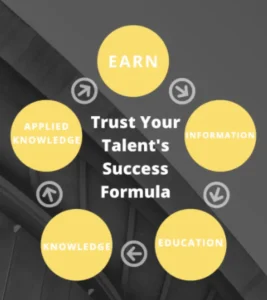
Information
Information is often times just facts about something — sometimes with more vivid descriptions of what’s happening. This is the starting point of the formula. As you can see, personally, I have nothing against it. I’m only concerned when most think that’s enough — especially when it comes to making investing decisions. If you are sensing my passion and amped up energy about this, I’m glad. This is the stage I was stuck at that caused my entire life savings to evaporate at the beginning of 2010. Imagine having just made some aspirational new year’s resolutions and personal goals to achieve just a few days ago, and learning that my hard earned (and “saved”) money vanished without a trace just like that?
Education
Now, education is usually information that has been interpreted and presented in a RELEVANT way to guide and increase the understanding level of whoever is receiving it. This is crucial because comprehension is key to maintaining a clear mind to process what’s to come. This is why we all hear the phrased “educated decision” these days. To me, it also speaks to personal accountability.
Knowledge
Then we get to the knowledge stage. This is when education has been internalized and has become integrated into our thought and decision-making process.
However, the old saying of “knowledge is power” is no longer the anthem people sing these days. There’s a new saying in town that rules now:
(Picture from Pinterest)
Or, to be more exact, what personal development guru, Dale Carnegie said:

This is why I am unapologetically pro-mentorship. I like to say that knowledge and education are just the ingredients and the tools that we acquire. A mentor is the fire under the pot to help us get things cooking so that we can get to the last stage — EARN.
Some examples lately I’ve seen to illustrate this phenomenon of getting stuck at the stage of getting information look like these:
- I will just learn how to invest in multifamily buildings and see how it goes.
- I am already using the BRRRR Strategy (WARNING: BRRRR is not a strategy — please read this if you haven’t already).
- I am learning so much from this podcast and reading so-and-so’s books.
- I have a close friend (or cousin) who’s a realtor and he/she knows a lot and said they will help me buy my first/next investment property.
- I see that everyone is going to the US or Central America to look for properties, that’s probably where I should go next.
This list is funny (and is actually much longer) for 2 reasons — one: I could relate before being serious about my financial education, and two: it’s actually not mine. This list was passed down to me when I first got trained to be an educated investor. I can still hear the trainer’s voice saying:
I’m not knocking any of these behaviours. If you look closely, every one of them is still an action statement — that beats doing nothing. It’s just that “if you want something you’ve never had, you’ve got to do something you’ve never done”. Many are simply falling into the definition of insanity — “doing the same thing over the over again and expecting different results.” If books and tapes (now podcasts) made a difference, I’d expect to see more Rolls-Royce and Bentley pull up in front of bookstores and libraries. Getting investing club memberships is like paying for fancy country club memberships and was never properly trained on how to swing a club.”
In the last few years, I’ve seen people go from novice in one strategy to “coach” status in less than a year. Bought a couple of properties in the US and calling themselves experts in cross-border investors. Hiding behind power team members to elevate their credibility (genius marketing move, no doubt).
Intimes like this — for those who are experiencing their very first downturn or economic recession — learn to differentiate information vs those who truly want to educate you, share the knowledge with you and help you leverage their experiences. Better yet, seek beyond information and ask: what does it mean to me, my financial plans, my growth and my decision making process?
Before there’s any type of S.M.P. (make sure you read/review the S.M.P. Philosophy article), there are 2 more things that come before it: Why/Purpose and Goal (mostly financial in this case). I’m passionate about elevating financial literacy in all mankind. Real estate investing is simply a tool and real estate is only an asset class that we leverage to demonstrate the principles.
Tomy dedicated readers, I thank you for your support and feedback. If this is the first time you’re reading one of my publications, I hope you’ve enjoyed it and learned a thing or two.
For those of you who are ready and or curious about how to create your personalized financial success plan, you can visit theBootcamppageortalk to a Strategy Coachfrom Trust Your Talent Academy to learn more. Take action now if you’re serious about thriving through the tough times and come out better at the end of all of this!

If you’re wanting to be a part of a community of real estate investors from around the globe, here is theT.A.L.E.N.T.ed InvestorsFacebook Group. It’s a place where people come together to share experiences, knowledge, successes and challenges, and money making opportunities!
For those of you who prefer watching videos, here isthe YouTube channelwhere some of my work (very raw) has been shared.
Lastly, I just want to say thank you for your continuing support. I aim to be authentic and adding value to your life.
It’s ultimately about LIFE and I appreciate you coming on this journey with me!
(Written in Edmonton, AB)

Financial Education through Real Estate Investing: 3 Reasons WHY Most People Fail at Leveraging Real Estate to Build Better Financial Results (Part 1/3)
October 18, 2022
This is a question that I get asked a lot during podcast interviews and Q&A at stage events. Plus, some of you have started asking me this very question over the last few months now so I thought it’d be fitting to share, not to mention timely in today’s world.
Before I get going on this, I should clarify that I’m cheesy as hell when it comes to viewing all versions of the word “fail”.
I do not believe in failures.
I believe in growth and learning.
I believe in never giving up. I believe in “fall 7 times, get up 8.”
So, let’s dig in!
Here’s the first and BIGGEST reason that I’ve experienced and witnessed:
. Old & Outdated Money Blueprint
I remember half-way through my Real Estate Investing Bootcamp back in June 2010. Having made the decision to get financially educated, I just needed to pay the tuition now. The only challenge is: I had just lost all my hard earned savings (as shared in previous articles). We had just moved to a brand new city and house 4 months prior and incurred a lot of surprise expenses through bad debt. How are we going to make this happen?
Both of us started calling our family and friends to share this new “business venture” that is real estate investing with them, and how we would treat them as our very first angel investors and pay them back tenfolds when we made it.
A couple of 28 year-olds went nowhere with those conversations.
Side Bar
If you’re reading this and you are a young entrepreneur, I’d love to hear your business ideas if you’re looking for private funding/angel investors. I have a soft spot for you because I was you. Over the years, we have backed and supported various small ventures to get started — some went well, most went bust and it fuels our souls to see how they all grew from the experiences.
Asa last resort, I called my parents who have been wanting me to pursue a MBA (Masters of Business Administration). I gave them my best“accomplished 28 year-old, middle-management title, earning-6-figure-income, and managing-50+-people across Canada”pitch at the time. Their response was the most awful and the most awakening.
During the Bootcamp, I had so many ah-ah moments that directly targeted at the heart of all my limiting beliefs when it comes to money. These ah-ha moments ripped many of the limiting beliefs out of my mind and my heart like poisonous weeds preventing a beautiful, fertile garden to blossom.
First thing I do have to say is this:my parents didn’t know what they didn’t know. They were only wanting the best for me. And here I am already thinking:If I want something I’ve never had, I’ve gotta do something I’ve never done.This includes breaking free of so many outdated money blueprint given to me by my parents. They refused to support my journey to be financially educated and yet were willing to remortgage the house to send me to grad school. The two people that rarely agreed on much and THIS they aligned on. This madness had to stop.
I refused their offer to get another degree. The bank of love was no love at all — or so I thought. I was angry — at them and at myself.
For people my generation especially, the last 2–4 generations all were raised in the industrial age where if you work hard, budget excessively and save, life will work out just fine. And it did — for them. I was born in 1982, the year where mortgage interest rates in North America were documented at 18% or higher. THINK about that! As a real estate investor and Mentor today, I teach everyone to conduct extra due diligence when someone’s offering double digits on a private lending deal.
Myconversation with my parents was one that burned me deep. Watching them struggle their whole lives to have a semblance of a comfortable life was the biggest lie they fed me growing up — unintentionally. Fortunately, my fears and self-doubt in the moment also got torched and turned into the fossil fuel I needed that night. The fuel that gave me the courage (or perhaps temporary blindness) to take the leap of faith to bet on myself.
I’m sure there’s more to this list as I’m only sharing some of the points they made that I still remember (honestly, a bit fuzzy now). If you have more to share, please feel free to comment as it may help others relate to this topic better:
- Money is the root of all evil and you don’t need much to live.Misquoted by them and I didn’t want to just live and survive through this lifetime, I wanted to thrive and have options in life — especially after 2 heart attacks at a young age, a heart surgery at 20 and an autoimmune disorder that I have to manage daily.
- You have a good job (good pay, ok benefits, company stock options, pension, extra play money) and just keep climbing the ladder.I just knew I was made for more. If for nothing else, I want to build my own ladder in life, not just for a job or career.
- You need money to make money. You’re just a kid, who’s going to give you the money (after sharing with them the idea of OPM — other people’s money).I was now armed with knowledge — and soon support through mentorship — that would prove anyone at any age can succeed with a strong why and proper guidance.
- It just sounds too good to be true (how to create cashflow and higher returns than savings and stocks was a subject them and I had never heard of).Maybe…and what if it isn’t? Numbers don’t lie. I love the saying (forgot the actual quote): “All you need is one way to make it work.”
- How are you going to find time to learn and do this?I would time block. I would cut out some bad habits (notice not all). I would do whatever it takes.
- The market in Edmonton is bad right now, isn’t it?Financial education through real estate investing goes beyond the city/town we live in. Educated investors are performance based investors. Most people that buy stocks in Tesla, Amazon, Nike, Facebook or Google care if they are going to yield good returns. This is not different.
No offence to my parents. To be completely clear — I love my parents and have a lot of respect for them. They did their best based on what they knew. And I remember this thing my Bootcamp Trainer said: “Often time, the people who love and care about us the most are the ones that stop us from achieving our full potential the most. They also tend to share the same last name.”
I took it all in.
That night, I decided that I needed to break the mold.I needed to break free of my old money blueprint.
The next day, my husband and I invested ~CAD $50,000 in our financial education. 3 credit card transactions and a promissory note on the contract later, we walked away with a used Cashflow Game and a branded padfolio.
Did we just get hyped up?
Could we do this?
Were we just young and naive old hanging fruit for these ‘seminar people’?
The overdosing amount of self-doubt and fear crept in night after night like an excessive daily binge on junk food. In 2010, CAD $50,000 was a nice Mercedes-Benz PAID IN CASH. It was a healthy downpayment for a condo in Metro Vancouver and Downtown Toronto (yup, you heard that right).
Our only antidote at the time was a concoction of believing in ourselves and the new tools that we had gained at the Bootcamp. Interestingly and unsurprisingly, these tools are the same that we still use today when we experience the same two emotions that have destroyed more dreams and aspirations we know: fear and self-doubt.
Today, I know my parents are proud of what I’ve accomplished. For that, I’m grateful. Grateful for their rejection and grateful for their limiting beliefs. From that, I got stronger and better.
All along, I’ve wanted to create something timeless with my writing. This is not about the market conditions, or interest rates or even inflations. Yes, they are important facts to know and they are not the first thing any of us need to know.
Proper financial education allows any of us (yes, you heard that right again — ANY OF US) the ability to expand our means through growing our income streams and wealth in any market conditions. Even the perfect sh*t storm that we are all living through right now.
I hope this is offering some light for you. This ‘reason’ does not need to be as reason as long as you choose different. So that you can become different.
Tomy dedicated readers, I thank you for your support and feedback. If this is the first time you’re reading one of my publications, I hope you’ve enjoyed it and learned a thing or two.
For those of you who are ready and or curious about how to create your personalized financial success plan, you can visit the Bootcamp page or talk to a Strategy Coach from Trust Your Talent Academy to learn more. Take action now if you’re serious about thriving through the tough times and come out better at the end of all of this!

If you’re wanting to be a part of a community of real estate investors from around the globe, here is the T.A.L.E.N.T.ed Investors Facebook Group. It’s a place where people come together to share experiences, knowledge, successes and challenges, and money making opportunities!
For those of you who prefer watching videos, here is the YouTube channel where some of my work (very raw) has been shared.
Lastly, I just want to say thank you for your continuing support. I aim to be authentic and adding value to your life.
It’s ultimately about LIFE and I appreciate you coming on this journey with me!
(Written in Edmonton, AB)